
Chapter 1) How diversity in horseracing began, May 2017
A close look at the origins of the British Horseracing Authority's diversity policy, including the Oxford Brookes report and its use as a Trojan horse.

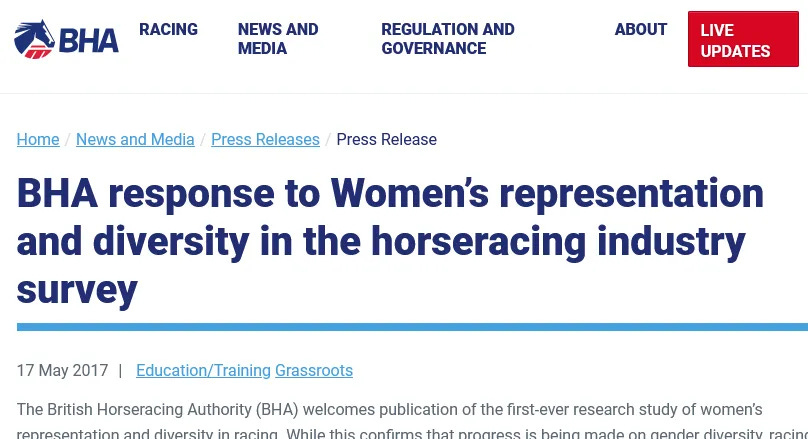
The BHA’s policy of “diversity” was announced on 17 May 2017; it took the form of a press statement,1 responding to a study by Oxford Brookes University into women’s representation in horseracing; here is an excerpt from the BHA’s statement with my emphasis:
The BHA welcomes publication of the first-ever research study of women's representation and diversity in racing. While this confirms that progress is being made on gender diversity, racing faces similar challenges to other sports in ensuring that people from all backgrounds are represented at all levels of our sport.
Focusing on the issue of gender diversity, the survey acknowledges that women are increasingly prominent in British racing, but it also confirms they remain under-represented, where just 16 per cent of people on Boards are women. Along with gender, age was raised as the most common factor for experiencing less favourable treatment, especially when people apply for promotion. Many people expressed more concern that our industry is not ethnically diverse; regrettably there were few people with a BME background who completed the survey. The number of men and women reporting discrimination or inappropriate behaviour in their responses to the survey is clearly a concern as there can be no place for this anywhere in racing.
… While we can be proud of a sport where women and men have the opportunity to compete on equal terms, we know from our own analysis that there is more to do to ensure that women are given the necessary encouragement, support and opportunities to be the best they can be.
The BHA produces press statements regularly and it didn’t seem unreasonable to me, as an employee, that steps should be taken to ensure women had a fair crack at the whip. What did seem odd, however, was the sentence: “we can be proud of a sport where women and men have the opportunity to compete on equal terms”.
Why should this be a source of pride as opposed to, say, delight? Men and women compete separately in most sports because men are on average stronger, but the situation is less clear in horseracing; in France, racing authorities provide a weight allowance for female jockeys, but in Britain, the view is there is no inherent difference in male and female jockey performance, i.e. riding is a matter of skill rather than strength. The British view may well be the correct one, but pride implies something more fundamental, that perhaps nature had erred and differences between men and women were undesirable; hence, the BHA’s “pride” in horseracing being an exception.
Kempton racecourse, January 2018
The second time diversity was referenced was eight months later on 11 January 2018, in a speech by BHA chief executive Nick Rust to eighty or so staff at Kempton racecourse. This event was one of three roadshow events for BHA staff; the following week, the roadshow went to Leicester racecourse, and then Newcastle where, presumably, the same speech was made.
Nick Rust said the Oxford Brookes report had exposed a major problem, the lack of diversity. Mr Rust said it was a disgrace (his word) that Kempton racecourse, on the outskirts of London, did not represent London’s racial demographics, and he called for a change in attitudes. He said “diversity is a strength”, and claimed the existence of two cases for diversity: a moral case, and business case. He reiterated more or less what was said in the May 2017 press release:
The business case for diversity is clear and unequivocal … not only is it fair, but study after study has shown that organisations take better decisions and perform better with diverse teams, and that tackling diversity issues has the scope to unlock huge amounts of potential, untapped talent.
The speech had the whiff of propaganda about it, and it also contained an incongruity; Mr Rust’s speech extended to racial diversity, whereas the Oxford Brookes report was about women's representation. So we need to back up and take a closer look.
The Oxford Brookes University survey and report
The Oxford Brookes report was based on a survey undertaken in 2016 by the university’s Centre for Diversity Policy, Research and Practice, led by one Professor Simonetta Manfredi. The survey and report were commissioned by Women in Racing, a group that sought female appointments at Board level;2 funding came from racing’s charitable arm, the Racing Foundation.
The trigger for Women in Racing’s approach to Oxford Brookes University appears to have been the Grand Women’s Summit, held at Aintree Racecourse three months prior in April 2016 to “celebrate the diverse roles women play in sport”. The event had the support of Nick Rust, who was quoted as saying, “I believe in gender diversity to help achieve success within any business and wish to gain broad support, from men and women, for women working in horseracing”.3
The survey was run online from 4 July to 15 August 2016, hosted on Women in Racing’s own website and consisting of 24 questions. Participants were told the survey “should take no longer than ten minutes to complete”, and questions revolved around matters such as whether women felt they had support in their career, access to training, whether they believed they’d been held back due to childcare responsibilities, positive and negative experiences, and so on. The survey had 393 responses followed by 16 telephone interviews, and findings were released nine months later in May 2017, in a 60-page publication entitled Women’s representation and diversity in the horseracing industry;4 this formed the basis of the above BHA press statement.
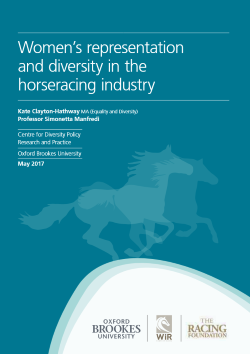
The aim of the report was to examine whether gender was a disadvantage in terms of career progression, with specific emphasis on leadership roles (p11). It’s evident on reading that the report reflected modern feminist thinking, that differences between men and women were a product of gender stereotyping and should be overcome. The report stepped over the question of “nature vs nurture”, whether women and men are drawn to certain roles because they are nurtured by society, or because of natural female and male inclination. The study’s modus operandi was to seek out differences between men and women in horseracing roles, and describe women as under-represented.
Trojan Horse
But why did the BHA’s statement of May 2017, and Nick Rust’s speech of January 2018, refer to ethnicity when the Oxford Brookes report concerned women’s representation? Of the Oxford Brookes report’s 60 pages, there was a short section entitled “Other areas of diversity” and one-half page of this referred to ethnic minorities; it said: “the rural nature of the industry is a barrier, given that the majority of people from minority ethnic backgrounds who come from the UK live in urban areas” (p42). The report added that “some” respondents expressed concern that the workforce was not ethnically diverse.
The significance of this half-page is that a survey concerning women’s representation had ethnicity tacked onto it, opening a door to matters the study was not capable of commenting upon. Let’s take another look at the BHA’s May 2017 press statement:
The BHA welcomes publication of the first-ever research study of women's representation and diversity in racing. While this confirms that progress is being made on gender diversity, racing faces similar challenges to other sports in ensuring that people from all backgrounds are represented at all levels of our sport … Many5 people expressed more concern that our industry is not ethnically diverse; regrettably there were few people with a BME background who completed the survey.
In this way, a report on women’s representation offered itself as a Trojan horse for ethnicity and race. And the term “diversity” is stretchable; LGBT was not mentioned in the “other areas of diversity” section at all, yet would go on to form a large part of the BHA’s diversity push.
What else do we know about the Oxford Brookes report? To find participants for its ten-minute questionnaire, a one-page promotion was placed in the Racecourse Association newsletter in July 2016, and presumably elsewhere.6
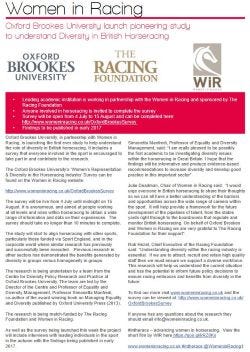
The promotion introduced the survey as a means to understand diversity in racing, but went on to say something else:
The study will start to align horseracing with other sports, particularly those funded via Sport England, and in the corporate world where similar research has previously and successfully been executed. Previous research in other sectors has demonstrated the benefits generated by diversity in groups versus homogeneity in groups.
The paragraph suggested an agenda that went far beyond women’s roles in racing, one that involved, for some reason, “alignment” with other sports and the corporate world. Simonetta Manfredi was quoted as saying:
“I am really pleased to be possibly the first academic to be investigating diversity issues within the horseracing in Great Britain. I hope that the findings will be informative and produce evidence-based recommendations to increase diversity and develop good practice in this important sector”.
This statement indicates that a finding in favour of “diversity” was intended before the survey had been conducted! Ten months later, when the report was released in May 2017, Simonetta Manfredi said she “… hope[d] the findings provide the strong evidence and recommendations that British horseracing needs to achieve greater diversity across its different functions”.7 This implies that Prof. Manfredi saw her research as promoting an agenda, rather than undertaking an enquiry.
Sally Rowley-Williams, the honorary president of Women in Racing, the body that commissioned the survey, said:
“Women in Racing will do all it can to facilitate change and make sure this research is just the starting point for taking forward the diversity agenda within British horseracing”.8
Women in Racing’s and Oxford Brookes’ statements revealed the 60-page publication as little more than a vehicle, enabling BHA chief executive Nick Rust to proceed with a policy that they had all seemingly agreed from the outset. Despite the fact that the BHA had not commissioned the report, Nick Rust adopted its findings the same day as its public release.
The BHA consultation
Let’s return to the BHA’s May 2017 press statement; what else did it say?
The BHA clearly has a role to play in leading the sport on the diversity agenda, but it cannot act alone. The business case for diversity is clear and unequivocal and everyone needs to buy into it.
The Oxford Brookes report was not a business case; it was a discourse on women’s representation. So, right out the stalls, we have a discrepancy as to the reason for the diversity policy; was it the Oxford Brookes report; or was it the “business case”? This discrepancy will be revisited in a future essay.
The May 2017 statement went on to announce a consultation, to get things moving:
As the survey report highlights, to be successful, this requires a cross-industry effort, so we will now consult with racecourses and horsemen on additional actions we need to take, including the recommendations contained in this report.
Given Nick Rust had just said “everyone needs to buy into it”, with actions “we need to take”, the consultation was little more than a rubber stamp. The press statement listed nine recommendations based on suggestions from the Oxford Brookes report. Some recommendations were so benign that no-one could possibly object; “successful role models”; encouraging everyone “to reach their full potential”; mentors to provide “support and guidance”. Other proposals lent themselves to mission creep: “exploring the need” for regulatory changes; “advisory targets” for representation on Boards; “unconscious bias” training.
The consultation’s main significance, however, was that it enabled the amorphous concept of “diversity” to be slipped in as BHA policy; I say “slipped in” because the consultation asked views on individual recommendations, not whether “diversity” should be adopted as policy. Just as the Oxford Brookes report sought to justify views already held, the consultation implemented a decision already made.
It should be stressed this isn’t the way the BHA normally operates; its 2021 review into the whip, for example, was conducted in a serious and detailed way; the consultation, which had its own steering group, was conducted first and then the report with recommendations was written. The BHA’s diversity policy was reached in the reverse order, and in a manner that was clownish: a women’s pressure group approaches feminist academics to produce a pro-diversity report, which the BHA’s chief executive instantly adopts as policy; that policy is then extended to diversity categories not covered by the report.
Women in Racing’s mission statement was “To encourage senior appointments at Board level across the industry and to attract more women into Racing, to strengthen connections and collaborate on approaches to help promote the health of the sport and to enhance its reputation as an attractive sector in which to build a career”.
The report’s reference to “some” respondents expressing concern (p42) was changed to “many” in the BHA press release.