
Chapter 11) The Uncomfortable Race, May 2021; and racing's changing relationships
Josh Apiafi interviews three young black men regarding horseracing and Black Lives Matter.

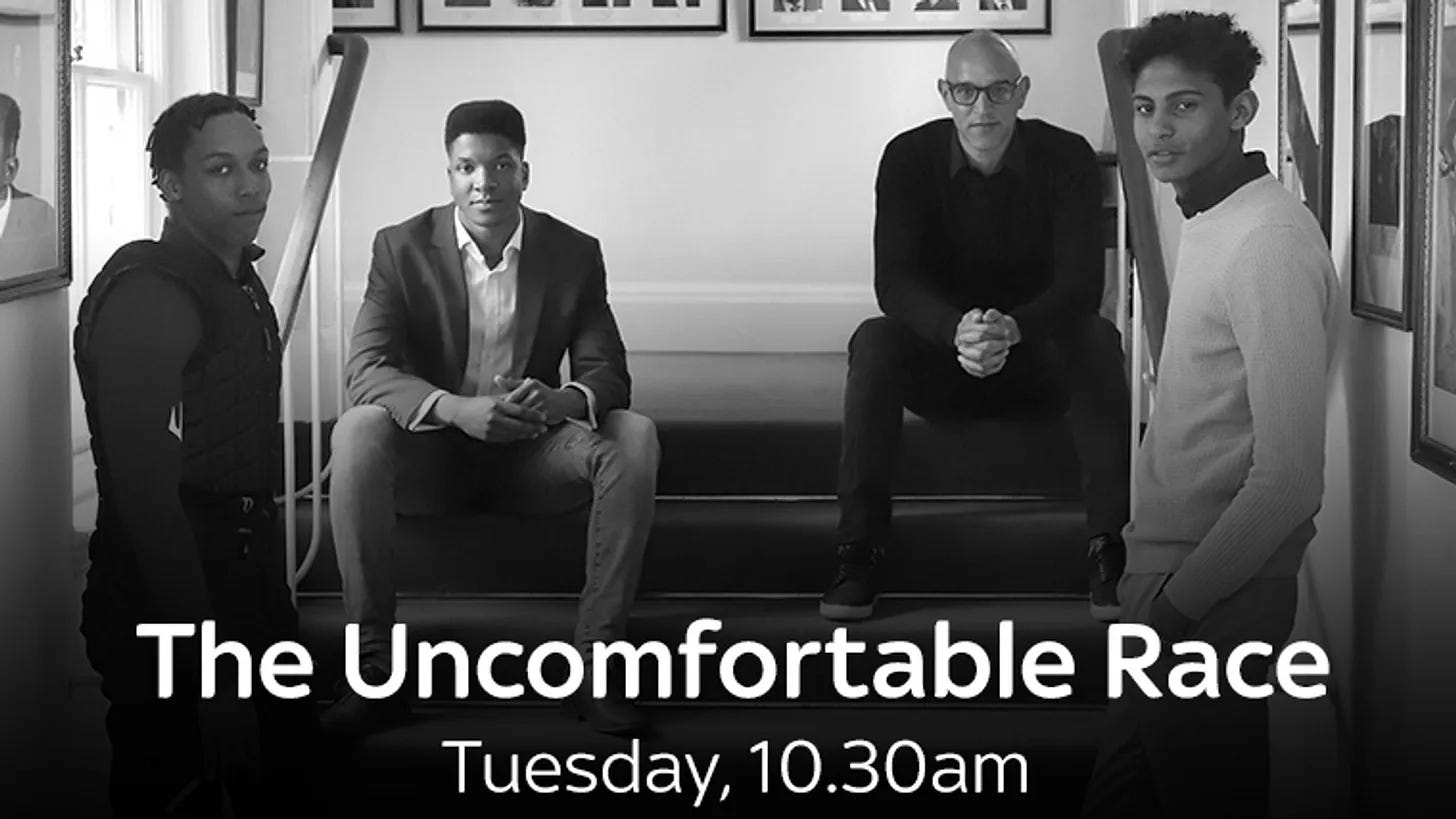
On 25 May 2021, the first anniversary of the death of George Floyd, Sky Sports Racing broadcast The Uncomfortable Race,1 a 21-minute television feature in which Josh Apiafi interviewed three young black men to “find out how the industry’s reaction to the events of the past twelve months has affected their view of the sport they love”. The three were aged 20, 20, and 24: Elijah M, Kanane F, and Callum Helliwell.
Josh Apiafi introduced the feature:
“Following the murder of George Floyd, protests quickly spread around the world as people expressed their anguish and anger over the death of yet another black person at the hands of the police. Global organisations reacted by publicly showing their support for a universal effort to address and eradicate racism. So too did the world of sport … taking the knee as a sign of support for the Black Lives Matter movement. But in horseracing, immediate action was not forthcoming”.
Josh Apiafi’s introduction was misleading; he implied that black people had been repeatedly killed by police because of their race, while stopping short of saying so, and described the death of George Floyd as “murder” without explaining the US verdict was nearer to manslaughter under British law. Mr Apiafi reiterated the claim that the British Horseracing Authority (BHA) did not respond to Black Lives Matter, but this time gave himself wiggle room by adding the word “immediate”. The documentary also repeated a clip of Rishi Persad’s claim that, “There’s been no gesture whatsoever from anybody in the sport” (see Chapter 8), illustrating how the BHA’s failure to demand a correction in November 2020 led to the false assertion being broadcast a second time.
Right from the outset, therefore, the documentary framed diversity and inclusion around the death of George Floyd, and the supposed wrong-doing of people in horseracing for not reacting in a certain way. This set the scene for the rest of the feature, half of which consisted of the three interviewees saying horseracing was insular. Repeatedly, they put the onus on horseracing to approach black people, rather than on black people to make their own decision to go racing:
Elijah M: “Horseracing is not ... an institution that is really going out and really engaging with the world around them, and in that sense it is very separated”. (9m 15s)
Kanane F: “They [horseracing] need to come out more [to] society and [be] not trapped in their little bubble and it will be good to bring them to places like Leicester, Birmingham, central London”. (9m 30s)
Kanane F: “They’ve not pushed it out as much as they should to allow people to understand that this is a pathway that they can actually choose”. (15m)
Elijah M: “I would love to see racing engaging more with the wider community because ... when you watch racing it’s in these small pockets of the countryside and it’s very out of touch with reality”. (17m 45s)
Kanane F also said:
“At the moment, it’s a big bubble; they don’t want to be involved in the outside world or doing anything that the world is actually getting on with; it’s just racing and racing, and that’s it … Even when I was riding out, you don’t hear anyone talk about anything else but racing”. (16m)
Racing people talking about racing! What evidence is there horseracing had left black people out of its bubble? The facts are as follows:
Racing is televised and every home in the country with a television set receives racing pictures; racing news and results are reported in newspapers and on the radio; racing is advertised at railway stations, on the side of buses, and on the London Underground; racing is also accessible online. Just because racehorses aren’t in the centre of Birmingham is not a reason for people not to know horseracing exists.
What about accessibility? All racecourses are accessible by road, clearly signed and with suitably sized car parks. Most racecourses can be reached by railway; Kempton Park racecourse is next door to the station; Sandown is a short walk from Esher railway station. Racecourses a mile or more from the railway station, such as Newmarket and Epsom, lay on bus shuttles. Windsor can be reached by riverboat. Racecourse websites have “getting here” pages and accessibility guides.
The notion that black people are cut off from horseracing by living in cities is absurd; cities are the centre of advanced transport networks, far more so than English villages. Josh Apiafi did not challenge the young men on any of these points, allowing the industry to be painted as distant and aloof.
One of the interviewees said: “We just want to be given a fair chance, we want to share the same opportunities that those who are born into those horsey backgrounds actually do” (20m 35s). But black people are not denied a fair chance, either. Jobs at yards, racecourses, and elsewhere are advertised, for example on Yard and Groom. Trainers, when not advertising, are approachable. While it’s true to say people born near racecourses or with racing connections have a head start, they have a corresponding lack of advantage in other sports, and walks of life such as city jobs, tourism, the coastal industry, theatreland, oil and gas, etc. Mr Apiafi failed to mention any of this, so it was unclear what complaint the programme was making, other than British horseracing communities are “white”.
George Floyd
Josh Apiafi sought the young men’s views on George Floyd; he said, “Over the past twelve months, diversity and inclusion, since the death of George Floyd, has come more to the fore in the media, how has this affected you as a young black professional?”
Callum Helliwell: “As a black person, if I see a man with a knee in his neck who cannot breathe, and being filmed and killed in front of people – again by a police officer in broad daylight - and racing can just ignore that and continue on and act like nothing had happened, rather than just putting in a single bit of acknowledgement, a black square for God’s sake on your social media pages; if you can’t do that, then what on earth are you going to do when something else happens?” (2m 20s)
Elijah M: “It’s affected me a lot. There was a part of me that thought that racing was ultimately late to the party. It’s taken so long to be recognised, and to be honest it’s still not fully recognised it”. (11m 10s)
Callum Helliwell: “I think racing’s been left behind, I think racing has been left trailing by other sports ... racing should take heed from these other sports and understand that … it is right to show support for the Black Lives Matter movement”. (11m 25s)
Kanane F: “In racing, they should push it through a lot more - at least do something to show they do support them [Black Lives Matter], even if it’s not big”. (12m 20s)
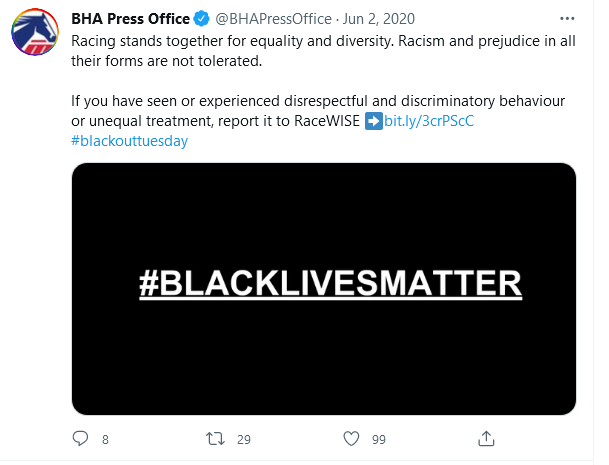
Note how the BHA’s promotion of Black Lives Matter the previous year (Chapter 5) had gone entirely unnoticed. An objective interviewer would have corrected them, or established facts ahead of the interview; for example, the BHA did put a BLM black square on social media:2
Josh Apiafi said George Floyd’s death was:
“… a statement of what happened for hundreds of years, I think. It’s not just the actual physical gruesome of murder of George Floyd; it’s what it stood for, in terms of white supremacy, and in terms of inclusiveness, a full diverse generation coming through”. (17m 10s)
Mr Apiafi’s symbolism was explicit: Derek Chauvin’s knee on George Floyd was the symbol of a perceived “white supremacy” that existed for hundreds of years, and the desired response was a “full diverse generation coming through”. This suggests the objective was not encouraging black people to go racing, but something deeper: the levelling of a historic scorecard.
The most significant aspect of the programme, however, was not its framing of George Floyd’s death, or how it portrayed horseracing as an inaccessible bubble, but its underlying assumption that racing’s British workforce and audience must stem from injustice or exclusion, rather than reflect an existing demographic and historical fact. This assumption carried the expectation that horseracing authorities should implement demographic change - this, of course, being the whole point of horseracing’s diversity and inclusion policy, which the documentary was intended to accelerate.
A green light
Racing began – notionally – when two riders raced to the end of a field for a wager. At some point, perhaps because of a dispute as to the winner, a referee was appointed. The point is that racing came first, the referee second; prior to racing, the referee had no reason to exist. Today, the referee is the BHA; it has developed regulatory and governing functions, but it is an outgrowth of the industry, not the industry itself.
By promoting diversity and inclusion, the BHA has given employers a green light to replace indigenous employees, particularly stable staff, with non-native labour. The issue is not so much that the BHA has sided with employers against staff - which might be a legitimate position in a given circumstance - but that it has fundamentally changed the underlying relationship; previously, the BHA governed a British workforce; now, through its emphasis on diversity, it governs a global workforce. This creates a conflict of interests between native employees and their new competitors. During the documentary, Kanane F said:
“Not many people have tried to interact with me, speak to me on the yards, even when I’m riding out, I get the dirtiest looks, you can see people [thinking] why are you here, you don’t fit in, you’re not meant to be here ... I try to keep going with what I want to do because I just want to make these boundaries open up to a lot of other kids like me because it would make the industry a lot better and help the industry to bring diversity around, and help to push out the word” (7m 25s).
Here one sees the problem; a young black man perceives that he, as an outsider, is unwelcome on an English stable yard; but he also says altering the staff in the favour of his racial kin makes it “better”. He does not see the inconsistency, that this could impose a similar sense of exclusion on the existing British workforce.
This tension reflects two interests: one is the right of British racing employees to exist as sovereign British workers on British soil; the other is the natural desire of non-Britons to establish their own presence. British stable staff (allegedly) give “dirty looks”, but that is all they do because the large number of non-indigenous and foreign staff employed in the industry have the support of racing’s authorities. British staff cannot seek that the BHA protects their native and sovereign status because, under the logic of diversity, that is “racism”.
These conflicting interests presented the BHA with a decision; what should it have done? It could have said something along the following lines:
The British state’s policy of changing the country’s demography is not a matter for horseracing’s governing body. People from immigrant backgrounds are welcome to apply for jobs alongside British staff; we will ensure they are treated equally, and can enjoy horseracing on the same terms; but we will go no further; we will not be propagandists or facilitators for a wider government policy.
Had it done so, the BHA would have both respected the native workforce and accommodated the new workforce as individuals rather than as representatives of groups, and so protect its impartial name. Instead, it did the opposite; by adopting “diversity and inclusion”, the BHA became an active agency for implementing demographic changes to that portion of British society over which it has regulatory power - to be explored later in this series.