
Chapter 13) An exchange of emails with the new chief executive, May 2021
Newmarket or Minneapolis? Regulatory overreach, and the ongoing redefinition of "racism" in racing.

The anniversary of George Floyd’s death, 25 May 2021, was marked by horseracing organisations; the image below was produced by Great British Racing (GBR), racing’s marketing arm.1
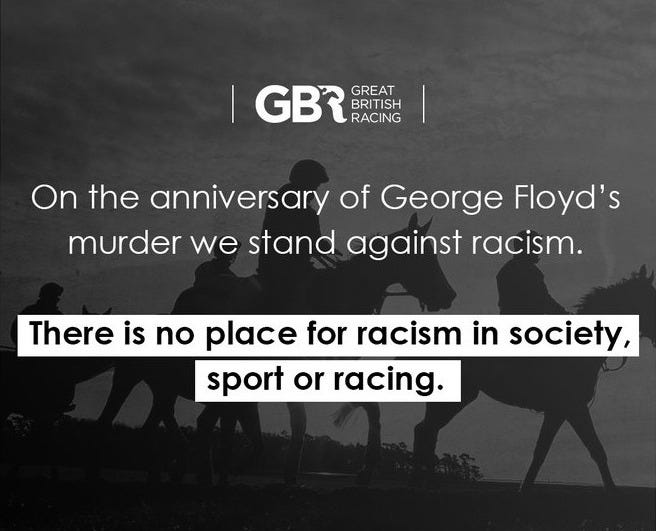
The first sentence is misleading because (a) it implies Floyd’s death was related to race, when race played no part in the charges, trial or conviction, and (b) fails to clarify Derek Chauvin’s central conviction rested on unintentional killing through excessive force, not premeditated murder. These points are important because a number of horseracing executives and personalities had appeared to accept the idea that Floyd’s death was part of a wider pattern where American police were routinely targeting unarmed black people with fatal violence.
Why did they believe that? Possibly because popular media would headline the fact that 1,000 people were shot dead by U.S. police annually while emphasising stories of unarmed black victims, thus causing the misperception. The actual number of unarmed black people fatally shot by U.S. police in 2019, the year prior to horseracing’s interest, was 11, alongside 26 unarmed white deaths and 11 Hispanics.2 Most black people shot dead are armed with handguns or other weapons (242 in 2019, alongside 387 white people and 154 Hispanics). It is true to say black fatalities are twice as high per head of population as white fatalities, but not when circumstances are taken into account, such as level of threat to police (48 police officers were also killed in 2019).3 Overall, in a country of over 330 million people, use of fatal force by U.S. police is exceedingly rare.
And yet, horseracing executives chose to believe what the media appeared to convey. This belief was reflected in the image above, whereby the first sentence (“On the anniversary of George Floyd’s murder we stand against racism”) creates momentum for the second - “There is no place for racism in society, sport or racing”. What, then, is meant by “racism”?
Previously, the word racism would be assumed to mean racial discrimination, but as noted in Chapter 10, the diversity policy combined with BLM/George Floyd narratives changed the meaning to numerical imbalance or, more pointedly, the presence or activity of white people without black people. Thus we arrive at the notion that horseracing itself can be said to constitute “racism”.
The Email Exchange
New BHA chief executive Julie Harrington chose the anniversary of George Floyd’s death to invite BHA and GBR staff to a Zoom call entitled “Let’s talk about race and ethnicity”. Her email expressly referenced the “changed understanding” of “racism”:
Today is the anniversary of the murder of George Floyd. His tragic death has changed the conversation and understanding around racism and discrimination – leading to people from all over the world sharing how they are affected by these issues. Racing is no different, with Josh Apiafi, Sean Levey, Rishi Persad, and Sulekha Varma sharing publicly their personal experiences of working in our sport.
We want to continue this conversation, and our live Q&A session will aim to:
Help us understand some of the challenges faced by ethnically diverse communities
Learn from other people’s personal experiences
Open the conversation – giving everyone a chance to participate.
I want to continue my learning in this area, so will be joining the panel … Improving diversity and inclusion is one of the BHA’s priorities, and this event is part of a wider Action Plan, which we will share more about in the next All Staff Call. This BHA Plan is part of a unified industry commitment to improving diversity and inclusion in our sport agreed by industry leaders.
Our commitment to greater understanding and action on ethnicity will build on existing initiatives, including Careers in Racing’s “Step on Track” programme … designed to introduce young people from Black, Asian and minority ethnic backgrounds to the horseracing industry. Racing is typically welcoming to anyone interested in our sport, but I am sure there is more we can all do to understand and address any barriers to attracting the employees and customers of tomorrow. I hope you will be able to join us on 8 June for this event and take part in this important conversation.
In one sense, the email was welcome; former chief executive Nick Rust had not approached staff in this way. But the email also referenced the “unified industry commitment to improving diversity and inclusion” and a “wider action plan”, indicating the matter was not up for discussion. I mulled over this invitation; I did not want to ask awkward questions during a live discussion so sent Julie Harrington my views, copied to Chairwoman Annamarie Phelps, beforehand:
Dear Julie,
Thank you for your email, and for arranging the BHA's first Q&A on this topic. My views are below. Please note, for my own protection, I will not be adding to this statement or entering into discussion regarding it. If you choose to address these points in the Q&A, you are welcome to attribute them to me.
i) If evidence exists of discrimination by racecourse staff, employers, etc., this is properly dealt with under the Rules of Racing or other legal remedies.
ii) So long as people are free to exercise consumer choices, and job applicants protected under employment law, the regulator has no reason to be interested in this matter. Any demographic changes in horseracing should occur organically, and the pace determined by individual choice.
iii) Matters relating to Black Lives Matter and the George Floyd case (which was not race-related and remains under appeal), and suggestions of “white privilege” and “systemic racism”, are subjective, and open to double standards.
iv) Accommodation of Sharia law should be made only after profound circumspection.4
v) The wider question as to Britain’s demographic future is a matter for Parliament. It is not for the governing body of horseracing to express a view either way, whether on its own volition, at the behest of activists, or on behalf of the State.
Julie Harrington replied the following day. While acknowledging the views in my email, she expressed a very different view of the BHA’s involvement:
Dear John
Firstly I am happy that you feel comfortable sharing your views. We have asked the moderator to build some of the themes you mention into the Q & A. I am sorry you do not wish to enter into further discussion at present, I hope that as the conversation develops you will feel happy to add your voice.
This is just one area of inclusivity in which we hope to build confidence in our team members to discuss. We should all feel happy to discuss if our organisation and our sport is as welcoming and inclusive as it might be.
My own personal view is that the BHA’s role is broader than that of regulator. I also believe that to be welcoming goes beyond enforcing rules. Leaving matters to existing rules, regulations, laws etc. and as a matter for parliament will not progress positive change. Without people and organisations taking individual responsibility and pushing for change, women still wouldn’t have the vote and gay relationships would still be illegal.
As I say that is just my view, I hope the conversation today will allow us to hear some other views and discuss what role the NGB [national governing body] of a sport should/could be in these areas.
Best Wishes,
The final two paragraphs state a “personal view”, but diversity was declared policy. The penultimate paragraph drew analogies to women’s suffrage and the decriminalization of homosexuality, but no comparable discriminatory laws exist to bar black people from horseracing. So, the reply sidestepped the issue in hand - whether a sports governing body should be adopting views on matters unrelated to its proper remit.
Where a sports governing body would have grounds for opining is if black people were not allowed to participate in racing, similar to the restrictions on women being professional jockeys prior to 1975. If such a restriction existed today, it would be perfectly justified for the BHA to take a view, since this is both relevant to the industry and restrictive to one section of the population. But no such discriminatory rules exist against black people.
How did we end up here? A succession of senior executives had adopted a worldview which they regarded as a moral crusade, with George Floyd its martyr and Derek Chauvin the symbol of oppression. Here again is the second paragraph of Julie Harrington’s first email; it runs from George Floyd’s death straight to the “personal experiences” of non-white people in horseracing:
Today is the anniversary of the murder of George Floyd. His tragic death has changed the conversation and understanding around racism and discrimination – leading to people from all over the world sharing how they are affected by these issues. Racing is no different, with Josh Apiafi, Sean Levey, Rishi Persad, and Sulekha Varma sharing publicly their personal experiences of working in our sport.
Chairwoman Annamarie Phelps used similar wording when speaking to the media: “George Floyd’s tragic murder … led to black communities all over the world sharing how racism and discrimination affects them … Racing is no less impacted”.5 The jarring linkage - running directly from George Floyd’s death to “personal experiences” in British horseracing - implicitly aligned white people in the sport with Derek Chauvin’s knee on George Floyd’s neck.
The four individuals said to have shared these “personal experiences” can only be a reference to Sky Sport Racing’s “Leading the Way” TV series, in which Josh Apiafi interviewed the other three. However, despite Mr Apiafi’s probing for examples of racial discrimination, the interviews remained on role models and perceived under-representation.
The BHA’s senior leadership was aware there were people who disagreed with the worldview; for example, push-back to the Rishi Persad interview (Chapter 8), as well as more generally, such as the then imminent launch of GB News. In normal discourse, there would be at least two views - for and against - but the diversity and inclusion policy was oppositional; use of words such as ‘racism’, ‘homophobia’, and ‘transphobia’ rendered disagreement morally illegitimate, meaning naysayers could not be seriously engaged with. The “unified industry commitment” formally entrenched this, with the result that there was no way to press home an objection, beyond a polite email, because the idea that diversity could be wrong was itself precluded.
This point was added due to betting and alcohol-free areas having been mooted by former chief executive Nick Rust, reflecting incremental adoption of Sharia in other sports; for example, cricket grounds hosting communal Eid prayers, and the provision of “multi-faith” prayer rooms in football stadiums.
For example, Racing Post, 25 May 2021