

On 10 November 2021, the Diversity in Racing Steering Group (DiRSG), in partnership with the British Horseracing Authority, National Trainers Federation and the Professional Jockeys Association, held a webinar entitled, Let's Talk About Race.1 This webinar was advertised on Racing TV, and industry leaders were “strongly encouraged” to watch by BHA chairwoman Annamarie Phelps.2
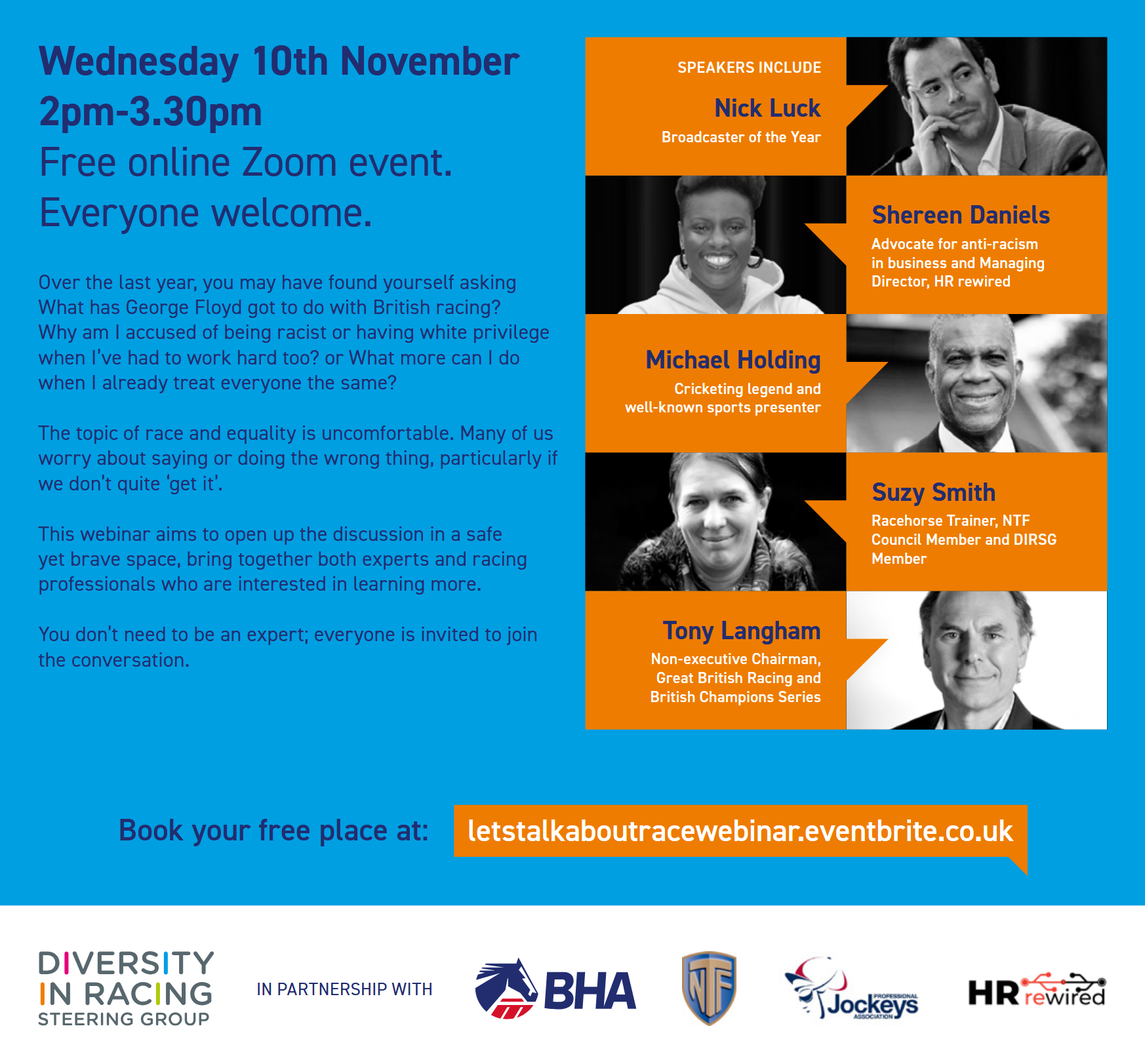
The webinar introduction was as follows:
The topic of race and equality is uncomfortable. Many of us worry about saying or doing the wrong thing, particularly if we don’t quite ‘get it’. This webinar aims to open up the discussion in a safe yet brave space, bringing together both experts and racing professionals who are interested in learning more.
The webinar was hosted by racing broadcaster Nick Luck and included Shereen Daniels from diversity consultancy HR rewired,3 Tony Langham, non-executive Chairman of Great British Racing, trainer Suzy Smith, and former West Indian cricketer Michael Holding.
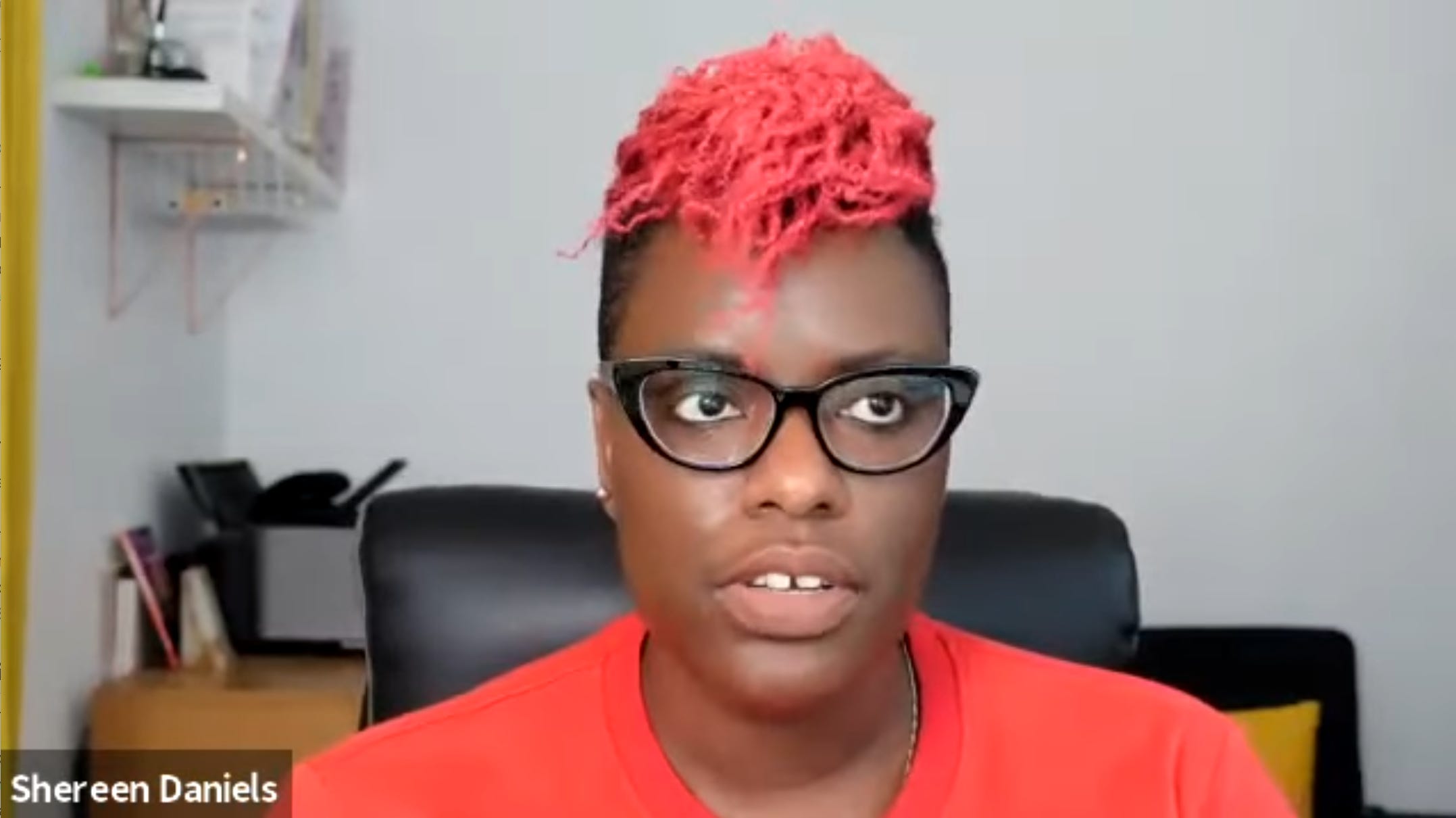
During the 90-minute webinar, the word “racism” was used at least a dozen times, but never quite defined; the panel would refer to the “problem”, “issue”, or simply “it”, but not explaining what “it” was, other than reverting back to “racism”, “white supremacy”, etc. Shereen Daniels, the black consultant, said:
“This is about making a difference and understanding that the world isn’t wired the way you thought it was. Going back to your original point about people understanding what racism is, the systemic elements of racism means it’s not just name calling and behaviour. It’s understanding that this hierarchy of where white people sit in accordance to other people of colour permeates with our systems, it permeates our views of what’s normal and what’s standard”. (20m)
Later, she says:
“This goes back to your earlier point about a lack of awareness and understanding about what racism is, because when you start to peel back the layers and you start to look at decision making, who gets to be the ones to make decisions, who’s in the room, who isn’t in the room, that’s when you start to recognise actually there’s probably some things we’ve just been used to doing and not questioning ... if you [respond by] ‘can’t we just get more black people into this room or into this business?’, you’ll get more diversity in a visual sense, but are you changing anything fundamentally in terms of racism as a system? The answer is no”. (27m)
What is Shereen Daniels trying to say? Imagine holding a handful of coloured casino chips. On the floor is a grid of squares. Give the chips a shake and throw them into the air; they land randomly onto the squares. What diversity advocates want to see is that each square gets a similar number of chips, and each square reflects the colours of the chips as a whole; no square with too many blue chips, or too few red ones. They envision a colour-blind and fluid society in which there are no uneven clusters.
The problem with this idea is that human societies are not formed by individuals falling from the sky: Europeans have European families; Africans have African families; the Japanese have Japanese families, and so on. People produce families, then tribes, and eventually nations, the organised expression of people of shared ancestry. The push for ‘diverse’ multi-ethnic societies runs counter to the organic way by which societies form.
What then is “systemic racism”? When English people pursue any activity, systems develop from it: racing horses leads to formal racecourses and training yards, which are then organised through entrance tickets, membership cards, licences, and so on. At the national level, this would include flags, laws, and borders. Thus, the accusation that “English society is systemically racist” simply means “English society is English”.
It’s like accusing African nations of ‘systemic blackism’, or declaring black people guilty of ‘blackness’. The word “racism” has little meaning beyond being a pejorative for English and European society.
Most people, however, do not unwind words in this way, so the white members of the panel were left to atone:
Tony Langham:
“I find it fundamental for me to say that white privilege exists and I would go further and say I do live in a society that is built on white supremacy ... it has to be white people, particularly white men, listening to stories of other people and putting themselves into other people’s shoes ... white men that need to change”. (23m)
Suzy Smith:
“… we already do have quite a diverse workforce but that doesn’t let us off the hook … a lot of us are guilty of thinking that inclusion is just being friendly to people in the morning … we treat everyone the same [but] we’re not hitting the crux of the problem and I think that’s because most people don’t realise … that we have had this unconscious bias”. (32m)
“Unconscious bias” was referred to again by Tony Langham:
“I do think you have to set yourself goals and rules and targets because unconscious bias is a thing. I write a lot and speak a lot, and I use other people’s quotes. If I just use quotes from memory … I will instinctively produce a speech that most of the quotes are in from white men because that’s what I’m programmed and hardwired into”. (30m)
I suspect the quotes from “white men” are from English-speaking men. Not always; our culture references Tacitus and Cicero, the ancient Greeks, Machiavelli, Tolstoy, and so on, but generally, English-speaking people draw on English-speaking writers: Shakespeare, Orwell, Dickens, C.S. Lewis, Jane Austen, Oscar Wilde, Mark Twain, W.B. Yeats, Benjamin Franklin, and many others.
Returning to the analogy of casino chips: the entire world’s literature and philosophy is thrown into the air, passes seamlessly through language, geography and time, and lands evenly across the world’s grid, so that an Englishman in Newmarket might quote a Japanese poet or Persian sage, as readily as he might an English playwright or American author. Such a notion is absurd, but people convince themselves otherwise because natural bias is reframed as “unconscious bias” and therefore bad.
A new mental starting point
The striking thing about the webinar was how the participants deconstructed British identity, and even British people themselves. The host Nick Luck mused:
“[Training horses] is a very white male profession and I’ve scratched my head for years trying to work out why”. (40m)
If Nick Luck had wondered why trainers were men, he would have just said “a very male profession”. The phrase “white male” indicates that men are not the subject, but rather white people. Combining “white” with “male” diffuses the focus just enough to miss the question’s implication.4 Let’s repeat Nick Luck’s question without the reference to men:
Training horses is a very white profession and I’ve scratched my head for years trying to work out why.
The effect of the statement is to declare demographic Year Zero and deny British people - the English, Scots and Welsh - as the normative population of Britain. In other words, “diversity” and “anti-racism” require a mental starting point that British people either did not exist, or are some sort of coincidence, or were formed only because of “racism”, rendering their existence illegitimate.
What did Shereen Daniels say in relation to horseracing?
“I’ve been offered twice in my history to go to Ascot and various other things and I couldn’t go because I’d be too worried that everyone’s looking at me because I’m the only black woman ... people think I’m the cleaning person or I’m the waitress serving the food ... I don’t see anybody looking like me there … whether that’s true or not you don’t know but nobody is stepping into saying this is how welcoming the sport is, you just go by the perception”. (45m)
As to why a black woman viewing horses in the parade ring would be mistaken for a cleaning lady is not explained, but let’s pass over that. Actually, no, let’s not pass over that. Doesn’t it occur to Shereen Daniels that her belief white people think she is a cleaner or waitress is her stereotyping white people, rather than the other way around? What is her actual complaint? She receives an offer to go racing, not once but twice, but refused to go because she felt uncomfortable among people who didn’t look like her.
Michael Holding, former West Indian cricketer, said (paraphrased):
“Because of the colour of my skin, people form an immediate impression of me. I have experienced this: someone once came up to me at the Epsom Derby when I was standing by a lift, dressed in my top hat and tails, asking for directions, automatically thinking I was working there”.
I think Mr Holding is wrong on that. It was his standing by the lift (as opposed to waiting for it) that drew a stranger to him. Hospitality staff often dress up; top hat and tails are worn by doormen at high-end London hotels and casinos; bar staff at the Epsom Derby wear waistcoats and bow ties. A visitor unfamiliar with Epsom’s distinctions may well have thought someone in formal attire standing by a lift was there to help.
But there’s another point to make: had Mr Holding been refused entry to the racecourse on account of his race, that would have been a relevant experience. Instead, all Mr Holding offered was being asked directions.
Yet on the basis of such nothingness, the webinar’s central message - that horseracing was implicated in “systemic racism”, “white supremacy”, and “white privilege” - was broadcast to 250 people in the sport, including people in senior positions. Even if some attendees saw through it, what mattered was that these ideas were given official endorsement. Racing’s diversity advocates were establishing the frames of reference by which people in the sport were expected to think.
Mr Holding was asked about his book, Why We Kneel, How We Rise. This goes some way to explain why the above prejudices against white people exist, and will be dealt with in the next Chapter.
BHA Board Meeting minutes, 18 October 2021
To put it another way, white men cannot exist without white women, so the term “white male” necessarily carries implications for European people as a whole.