
Chapter 4) 2019, the year things sped up
Horseracing discovers "pregnant people", Stonewall, transgenderism, hijabs, and pale stale males.

In the 2017 to 2018 period, there were long gaps of silence regarding diversity and inclusion in horseracing; almost a year passed between the formation of the Diversity in Racing Steering Group in August 2017, and its Action Plan of July 2018. In 2019, however, the pace quickened.
A staff survey, May 2019 (“pregnant people”, etc.)
In May 2019, the British Horseracing Authority (BHA) held an online survey for staff on “Equality, Diversity and Inclusion”. Note that a third word has now been added to diversity and inclusion; equality.
Questions reflected the new thinking; instead of asking whether staff were male or female, staff were asked, “Which gender do you most identify with?”
Another question was: “Have you ever been present when you felt that any of the following would not feel welcome in a BHA place of work, including racecourses, or at a work event”. The ten identity options to choose from were:
a member of the LGBTQ+ community;
person from a racial or ethnic minority;
different socio-economic background;
particular religious or political belief;
pregnant person or a person with maternity needs (e.g. a breastfeeding person or person who has recently given birth);
person of a particular age;
person who is married, or in a civil partnership;
person of a particular gender;
person with a disability;
women.
Does the reader notice any absences in that list? Women appear as an option but not men; racial or ethnic minorities are included, but not the majority indigenous British. White/British males qualify only if fitted into some other category, such as LGBTQ+, or having a disability.
Note also the fifth option; women who are pregnant, breastfeed, or who have given birth, are referred to as “persons”; in a very short space of time, the BHA had gone from expressing pride in May 2017 that males and females compete on equal terms, to seemingly abandoning biological sex distinctions.
“Racing With Pride” and Stonewall, June 2019
In June, the BHA launched a campaign to celebrate 50 years of Pride. Announcing collaboration with Stonewall, the BHA said, “this year racing will be coming together between 28 June and 6 July to be #RacingWithPride by sharing positive messages in support of our LGBTQ+ community and to celebrate 50 years of the Pride movement”.1
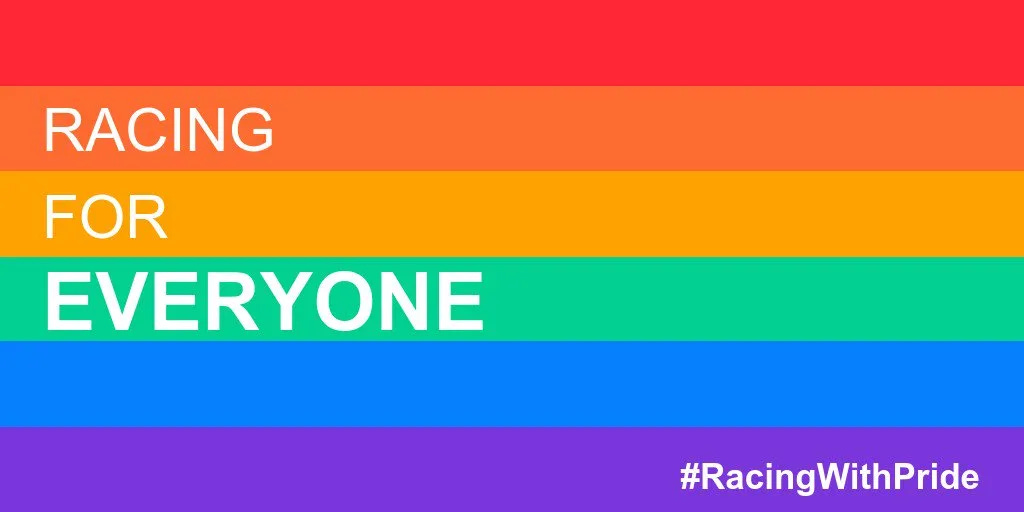
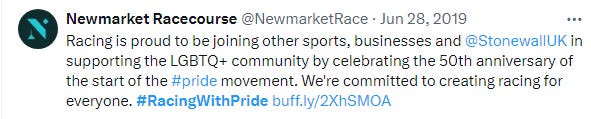
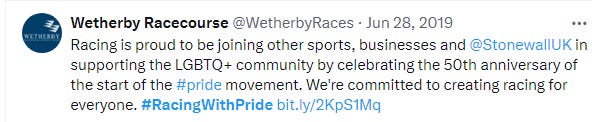
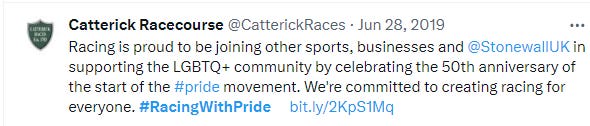
This was the first time that a diversity event had been rolled out across the whole industry, and it did so with uniform social media messaging; for example:
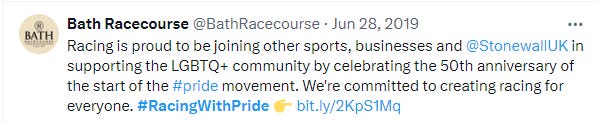
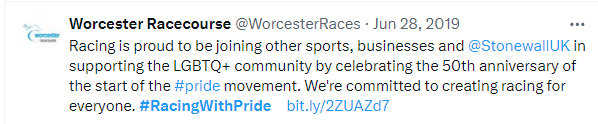
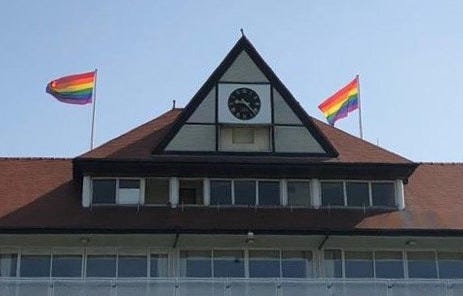
Racecourses also flew Pride flags; this is Chester:2
The campaign was said to make “all racegoers feel welcomed & accepted for who they are. Racing is for everyone”. Yet, no racecourse had a policy of making people unwelcome. People who were LGBTQ+ were free to enjoy the racecourse, order food and drink, place a bet, and watch the racing, like everyone else.
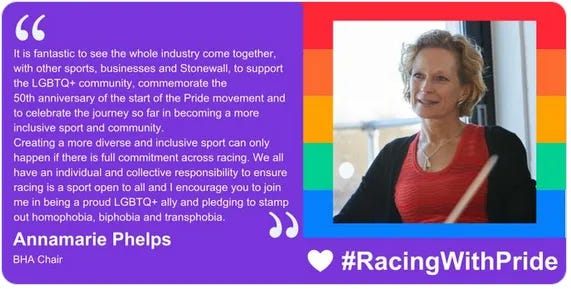
What was the point? The campaign turned sexual minority racegoers into a single category while placing an expectation on those falling outside that category to become their “allies”; BHA chairwoman Annamarie Phelps issued a statement calling on all to join her in “being a proud LGBTQ+ ally and pledging to stamp out homophobia, biphobia, and transphobia”.3
At around this time, I went to a cash machine during lunch, and was surprised to see an almost identical message appear on the screen. When one works in an organisation, one assumes its leaders write their own public statements, or at least have the PR department do it for them; but seeing my bank display the same message as Annamarie Phelps suggested the message had been produced elsewhere, probably Stonewall, and circulated among corporate bodies to use.
Magnolia Cup, August 2019 - Muslim hijab
Much publicity was given to 18-year old Muslim woman Khadijah Mellah riding and winning in the Magnolia Cup at Goodwood Racecourse, on 1 August. The Magnolia Cup is not a professional race, but an annual all-woman affair that combines charity, glamour, and publicity. Goodwood says the Magnolia Cup is to “change the perceptions of women in sport”.4
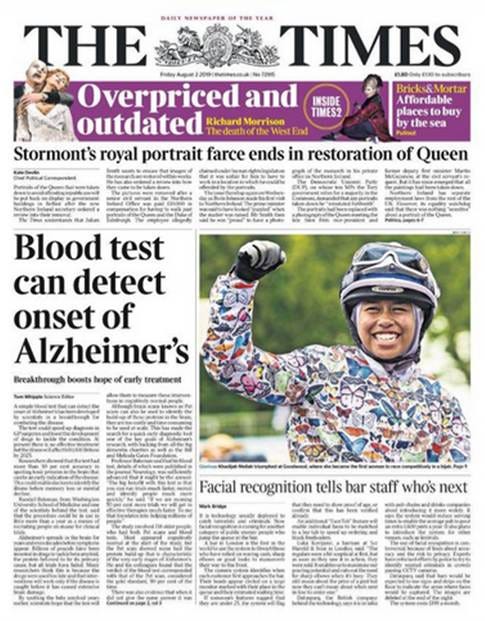
The Racing Post described Khadijah Mellah’s win as “ground breaking”, “the first woman to race-ride in a hijab”.5 Goodwood Racecourse also referenced the hijab,6 and Great British Racing said Khadijah made “history becoming the first British Muslim jockey in the UK to win a race”.7
This represents a major ethical conflict in horseracing’s diversity policy. At the narrow end, the hijab is a by-product of the Islamic assumption that women are ancillary to men, which presumably conflicts with the “empowerment of women” that the Magnolia Cup is said to promote. More fundamentally, promoting the hijab is a tacit promotion of Islam itself. Islam is a worldview that has no separation between Mosque and State, meaning commands of Mohammed, a 7th century prophet-turned-war chief, take precedence over laws and mores of non-Muslims; this causes parallel Muslim societies to form in the West, and the risk of Jihad, religious struggle, if the ways of Mohammed are not respected.
As the saying goes, the road to Hell is paved with good intentions; sentimentality over a smiley 18-year old in a hijab and talk of “changing perceptions” led to horseracing authorities flirting with Islam; no formal decision had been made to that effect; yet, it had been introduced all the same, via what was supposed to be a ladies’ charity race.
Transgender Day of Remembrance, October 2019
In October, the BHA marked Transgender Day of Remembrance, a day to “memorialize those who have been murdered as a result of transphobia”. A post on Workplace, the BHA staff website, said:
Why is this relevant to racing? An estimated 1% of the population fall somewhere on the broad “trans” spectrum (that’s 1% of our participants and racegoers too) and with racing having the first transgender jockey to ride in a race last year, it is important that the BHA are trans-inclusive.
BHA staff were invited to “Trans in the City”, an event hosted by BP in Canary Wharf for top employers.

RaceStraight becomes Racewise, December 2019
For many years, the BHA had a confidential telephone line called RaceStraight, horseracing’s equivalent of Crimestoppers; people could call it if they suspected suspicious betting and other integrity concerns. In December 2019, the BHA announced it was to widen RaceStraight’s remit to include Equality, Diversity & Inclusion, as well as other matters such as drugs and welfare; staff were asked to come up with a new name.
A few weeks later, RaceStraight became Racewise, where ‘wise’ stood for: Welfare, Integrity, Safeguarding and Equality. Traditionally, the ‘e’ in horseracing meant equine (Equine Welfare Officer, British Equine Veterinary Association, etc.). Now, “equine” made way for “equality”, and publicity material featured a black rider. Since the letter ‘e’ no longer represented horses, “welfare”, previously associated with staff welfare, was reassigned to horses, and staff welfare became “safeguarding”.

This game of musical chairs in terminology illustrated the BHA’s shift from an organisation that had horses at the centre, to one that centred equality and using black people as a symbol of this social mission. This is not equality in the sense of reducing inequality of income, but a stylised or visual equality achieved by placing black people among white people, or women among men.
Diversity in Racing Annual Update, December 2019
As 2019 drew to a close, horseracing’s Diversity in Racing Steering Group (DiRSG) produced its second report, saying that DiRSG had been “developing a closer relationship with the industry through the Members’ Committee”, and “raising awareness of the need to prioritise D&I at industry meetings across the sport”.

The Annual Update was more strident than its predecessor in mid-2018, speaking in terms of “accelerate progress”, “strive”, “push forward”, “springboard for further action”. It said, “Our ambition is for racing to be a sport for EVERYONE … Our focus will be on creating an inclusive culture and widening representation”.
The reality, however, is that horseracing isn’t for everyone, and it is inevitable interest correlates with diverse groups (otherwise, they wouldn’t be diverse). That doesn’t mean newcomers aren’t welcome at British racecourses, or that horseracing isn’t open to all; but the Action Plan wasn’t prepared to take no for an answer:
It is imperative that if racing is to become more inclusive and diverse, everyone within the sport must strive for one clear goal, a shared responsibility will accelerate progress. For this to become a reality, as outlined in the Oxford Brookes report, we must build a greater understanding of diversity issues and engage and educate stakeholders, participants and the workforce on the importance of D&I for commercial, legal and moral reasons.
Note the mild confusion as to why diversity was being adopted: the Oxford Brookes report of May 2017 is cited, while the former commercial and moral “cases” are subtly downgraded to “reasons”; and “legal” is added, when this wasn’t the reason given previously. The reason for this inconsistency shall be explored in a future essay.
Mission creep, meanwhile, including “considering targets”, was in full swing:
Unless we can understand the true and accurate make up of our workforce, participants and fans, and monitor any changes, we will not be able to identify the challenges or know the true impact. Once clear methods of collecting accurate data are identified we will hold the industry and ourselves to account by considering targets and publishing data.
“Male, pale and stale”
Despite all the above, it still came as a surprise a month into the new year when, at the BHA staff Roadshow at Kempton on 23 January 2020, chief executive Nick Rust declared British horseracing to be “male, pale and stale”. There was no reaction from the audience, other than to politely listen.
Prior to 2017, the word “diversity” meant the diversity of horseracing itself; jockeys, trainers, stable staff, owners, racegoers, breeders, bookmakers, punters, broadcasters, administrators, sponsors, racecourses and, of course, horses. In 2004, a former British Horseracing Board chief executive said in a speech:
This is a sport that is universally acclaimed for its diversity: from the Grand National at Aintree to a Bumper at Exeter, from the Epsom Derby to a Seller at Catterick, from the nuances of Chester to the expanses of Newmarket, from the recent and continuing development of All Weather Track racing to the splendour and undoubted highlight of the international Turf calendar at Royal Ascot, British Racing exemplifies diversity.
In an instant, all of that had been disqualified as “stale” by the BHA’s incumbent chief executive, and the word diversity redefined to mean multiple genders and ethnic difference. Anyone could have telephoned the newspapers during the tea break, told them of Mr Rust’s remark and get a headline, but nobody did; I doubt the idea occurred to anyone. Horseracing is a product of social trust, meaning strangers agree to be bound by a set of rules, as opposed to clan or familial loyalty. Yet, it was precisely this social trust that had been taken advantage of in the name of diversity, both in that moment and over the last two years.