
Chapter 7) Black History Month, October 2020
A critical look at Black History Month and lived experience in British Horseracing.

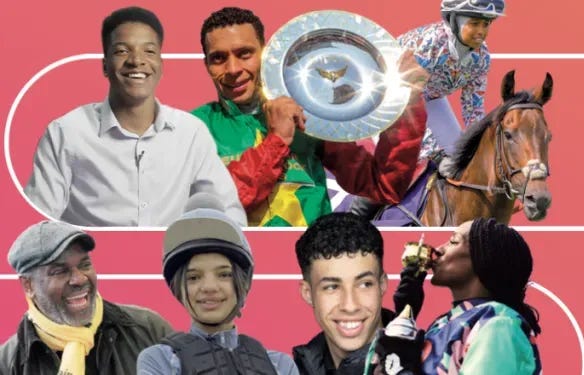
In October 2020, the British Horseracing Authority (BHA) marked “Black History Month”. It invited a black member of staff, who immigrated to Britain 19 years previously and who I anonymise as K, to write an online essay; the following is an excerpt:
I have been asked about whether the death of George Floyd and the momentum the black lives matter movement has had globally will bring about real change. I don’t know. I hope it will, but I think change will be slow as this is learned behaviour on both sides. I see initiatives; some are tokenistic, some make me cringe. Others are powerful. But racism, both conscious and unconscious, still runs deep in parts of our systems and structures.
This indicates Black History Month was used to continue narratives around George Floyd, started in June 2020 (Chapter 5). K wrote:
I have experienced racism, some of it overt, some less so. From the manner in which I was denied a bank account to the daily stresses of being questioned while commuting; being told that my appearance will affect my job prospects, that people can’t understand my accent (which I hope never fades!), and people’s manner shifting when they learned my name (and deliberately mispronounce it). If I get irritated, I’m immediately judged as the angry black woman who should “watch her tone”. Every time I enter a shop, I physically alter my behaviour to somehow show I’m not a thief. I don’t know a single black person who doesn’t feel the same, regardless of their wealth or status.
The above is what’s known as “lived experience”. The problem with lived experience is it allows assertions without evidence. Let’s take the first example, the denial of a bank account.
Any bank employee in this country who discriminates against black people risks the sack if found out. Although K is confident racial prejudice was involved, she does not explain why the bank account was denied, and refers instead to the employee’s manner, which is speculation. An alternative interpretation is the bank account was denied for procedural reasons, and this led to tension between K and the employee, which K attributed to racial prejudice.
Similar points could be made about the other incidents. K says she was told her appearance affects her job prospects, but “appearance” is a wide-reaching word, and her using it suggests something other than race, in which case, it is relevant to her claim of racial prejudice?
Her last point, “Every time I enter a shop, I physically alter my behaviour to somehow show I’m not a thief”, is an objective expression of her feelings; K is referring to what is in her mind, what she feels. Do shop staff do something to make her feel that way; look at her, follow her around the store? Maybe K is right and staff are wary of her, but it’s also possible K feels conspicuous and comes to the wrong conclusion as to what others are thinking.
What we don’t have in the cited stories is the version of events from the other side; the bank employee, the ticket collector or commuter, the shop assistant.
I wonder whether there was any attempt to nail down or refine K’s claims before they were published; regardless, the chief executive and chairwoman were on hand to affirm them in the online comments section:
Nick Rust: “That’s brilliant of you to write for us like that. Thank you. Helps us to reflect and learn”.
Annamarie Phelps: “Thank you so much for sharing your story. Please have the confidence to keep telling it, any month of the year, so we can all become more understanding of the issues people of colour face daily and we can work together to make the world a better place”.
The use of pronouns “we” and “us” identify who K’s story is aimed at (white staff) and imply Annamarie Phelps and Nick Rust were speaking for staff collectively; like Nick Rust’s “thumbs up” to BLM narratives (Chapter 5), it signals to staff the expected perspective.
Let’s test the matter by flipping it the other way around: an organisation draws attention to the killing of a white person by a black person, treats it as racially motivated, and asks a white member of staff in that context to describe their experiences of black people, leading to negative and subjective stories; and the CEO responds, “That’s brilliant of you to write for us like that. Helps them to reflect and learn”. Such a thing would be considered unacceptable and risk legal action.
And there’s another point. The chief executive and chair properly have seniority in the context of horseracing governance, but elevating a black staff member’s experiences, which they choose to identify with, implies moral seniority over staff in matters that are opinion, such as race relations, immigration, and what constitutes “racism”.
Black History Month is an idea originally from the United States, relevant to that country because black people were present as slaves during the USA’s founding in 1776. It fits less well in Britain, or not at all, because West Indians came to Britain via immigration within living memory, and African immigration is almost entirely post-Blair. Black History Month is particularly incongruous in British horseracing, and the absence of a black history was tacitly admitted by the Diversity in Racing Steering Group when it described black people in the sport as “trailblazers”.
Why, then, did the BHA adopt this notion of a “black history”? Probably, for the same reason it adopted concepts such as “pregnant people” and sex being “assigned” at birth (Chapter 4 and Chapter 6). These ideas formed part of a wider framework relating to various forms of identity, which were being ported in from external sources.