
Chapter 9) The Absence of Accountability - DiRSG Annual Update, December 2020
Horseracing's Diversity Steering Group becomes a law unto itself; Black Lives Matter revisited; and the "Jungle Bunny" incident.

In December 2020, the Diversity in Racing Steering Group (DiRSG) released its third report; like its second report, there was a ratcheting up of rhetoric:1
In Summer 2020, the UK witnessed an outpouring of anger against racism that was felt across all of society including sport, and racing is no different. The lack of ethnic diversity in some areas of racing has been acknowledged by the DiRSG since its inception, and it is accepted by racing’s leaders that change should be happening faster ... Crucially, this is not a one-time conversation. We can all learn from and support this new wave of awareness and solidarity and acknowledge that real change requires a long-term commitment from everyone.
Speaking of Josh Apiafi’s and Rishi Persad’s “Leading the Way” broadcast in November 2020 (Chapter 8), the Annual Update said:
They are right to point to racing’s failure to respond collectively to the black lives matter movement and to address the lack of ethnic diversity in racing.
The DiRSG was thus judging the racing industry. This was a long way off from its mid-2018 description of itself as an “advisory group”, and the Update sought to encompass everyone in the industry in its ambitions:
“… it is imperative that if [racing] is to become more inclusive and diverse, everyone within the sport must strive for one clear goal.”
“This will take collective commitment and effort but the sport will benefit as a whole.”
“The diversity and inclusion agenda requires long term commitment from all … [and] collaboration from the whole of British racing.”
“Being diverse and inclusive in how we think and operate is not a choice ...”
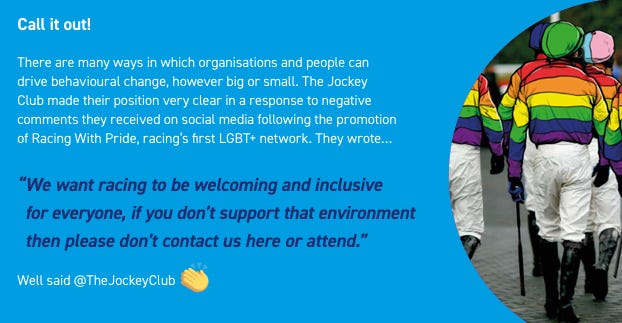
DiRSG’s expectation of compliance was underlined by its endorsement of the Jockey Club’s response in September 2020 to negative comments regarding the formation of Racing With Pride, a LGBT+ networking and activist group. The Jockey Club had said:
“We want racing to be welcoming and inclusive for everyone, if you don’t support that environment then please don’t contact us here or attend”.
The DiRSG Annual Update endorsed this message by saying “Well said” with a hand-clapping emoji:
I have not seen the negative comments in question, but generally such objections are not against gay people having social groups per se, but against LGBTQ and Stonewall activism within institutions, aimed at demoting the family and promoting gender-identity theory in youth settings. For example, whereas in May 2017, the BHA was “proud [to be] a sport where women and men have the opportunity to compete on equal terms”,2 DiRSG’s 2020 Annual Update changed this to, “proud to be one of the few sports where all genders compete on equal terms”. Racecourses had not yet introduced drag queens and LGBTQ dance stages, but these would soon follow.
The question of oversight
The Annual Update said DiRSG was “reviewed and supported by the industry’s Members’ Committee”.3 To what extent, then, did the Members’ Committee know what DiRSG was doing?
Did the Members’ Committee know that DiRSG’s LGBTQ sub-group denied the biological basis of male and female?
Had the Committee agreed to DiRSG’s e-learning module which tacitly advocated introducing gender theory into school classrooms? (Chapter 6)
Were they aware that Black Lives Matter, endorsed by DiRSG in June 2020, sought to “disrupt the Western-prescribed nuclear family structure”?4
As noted above, DiRSG was judging the industry, endorsing exclusion of discontented racegoers, declaring what everyone should do. On whose behalf did DiRSG speak? Who was in charge?
The DiRSG was not a formal BHA department; it consisted of numerous racing officials and personalities (Chapter 2), free to act independently and speak to the media outside of normal frameworks. Yet, DiRSG was lodged within the BHA; it used BHA premises for meetings, used BHA platforms for distribution of reports, and its chairman from 2017 to mid-2020 was the BHA’s own chief executive, Nick Rust — creating a Pooh-Bah-like arrangement in which the same person was both running the governing body and chairing the group advising it. DiRSG did not display the BHA logo, but it was a Department for Diversity in all but name. Given it was assumed to have expertise on diversity, it may have been the case that the Members’ Committee and boards of various horseracing bodies simply nodded through whatever ideas it proposed.
It should be borne in mind that senior people in horseracing have no familiarity with “diversity”. When horseracing is attacked regarding animal welfare, racing people respond with knowledge and confidence; they are on familiar ground. Accusations of being “white” or “heteronormative” or “racist” come from outside horseracing experience; their roots are in American liberal and Marxist academia. And whereas animal-welfare activists are transparent in their desire to end horseracing, diversity is presented as being in horseracing’s interests, and this is the cause of much of the fog.
Diversity, Equality and Inclusion consists of four elements:
a feminism that regards female competition for traditionally male roles as liberation, while treating the domestic or family-centred role as lesser or oppressive;
an LGBTQ activism shaped by Queer Theory that regards traditional family formation as “heteronormativity”, a structure of oppression;
gender theory that denies the biological reality of male and female (the ‘T’ in LGBTQ); and
Critical Race Theory that posits the founding population as ‘racist’.
No society can withstand these elements if applied indefinitely, but their deconstructive nature is not immediately apparent due to diversity’s colourful image; rainbow flags, pictures of happy ethnic minority children, female jockeys having won a race, and so on. There may have been an extent to which horseracing’s authorities were persuaded by this and just went along with it.
Diversity’s radical nature, however, became apparent when it went from being presented as an “exciting opportunity” in 2017-20195 to something aggressive from mid-2020; to re-quote the above paragraph from the Annual Update:
The UK witnessed an outpouring of anger against racism that was felt across all of society including sport, and racing is no different. The lack of ethnic diversity in some areas of racing has been acknowledged by the DiRSG since its inception, and it is accepted by racing’s leaders that change should be happening faster.
Note that “racism” is not racial discrimination, but simply the absence of “ethnic diversity”; British people existing among themselves is now defined as “racism”. Did the Members’ Committee agree to that passage; did they even understand its implication?
Black Lives Matter revisited: what happened in June 2020?
Horseracing’s highest decision-making body is the BHA Board; what role did it play in the mid-2020 escalation? The death of George Floyd was on 25 May 2020, and BHA chief executive Nick Rust, and Head of Diversity and Inclusion Rose Grissell, made their George Floyd and BLM-related posts on Workplace on 5 June (Chapter 5). But the decision to adopt this stance was taken at least three days earlier, on 2 June, when the BHA issued its Black Lives Matter tweet.6 This was the day after the results of George Floyd’s post-mortem.
The BHA Board met by video conference on 26 May7 (the day after George Floyd’s death), and again on 2 June8 (the day of the tweet), but the minutes of neither meeting record any discussion of George Floyd or BLM; horseracing had been suspended because of Covid for several months and was to resume behind closed doors on 1 June; that was the main topic of discussion. The absence from the minutes of a recorded decision to endorse Black Lives Matter and its associated narratives suggests the decision was not taken by the Board, but by chief executive Nick Rust, with the chairwoman Annamarie Phelps in tow, and presented as a fait accompli.
Just over a week later, Annamarie Phelps and DiRSG referenced each other in their mid-June articles (Phelps in the Racing Post on 14 June 2020, and DiRSG’s pamphlet Let’s Talk about Race in Racing, 16 June 2020; Chapter 5). This suggests Annamarie Phelps and DiRSG had been working together to agree a position on Black Lives Matter; if so, that would again indicate the Board was bypassed.
The above is of course conjecture.
“Jungle Bunny”
As 2020 drew to a close, an incident occurred that illustrated the climate that DiRSG had helped to create. On 12 December a filly, Jungle Bunny, raced at Chelmsford, a name that, unknown to almost everyone in racing, is regarded by some as a racial slur. When this was pointed out on social media, the BHA said, “This name is deeply offensive and should not have been permitted”; the following day it added:
“We reiterate today the apology that was issued yesterday after the horse ran. Racist language is not tolerated in our sport, whether intentional or accidental. We are opposed to racism and prejudice in all its forms and are committed to making British racing an open, diverse and inclusive industry that is welcoming to all. We have taken steps today to ensure the horse was renamed immediately. It is now called Jungle Bells. This will be reflected in records of the race result and horse form. We are deeply concerned as to how this happened and are reviewing the processes for approving the names of racehorses”.
The language indicates panic, and assistant trainer Emma Folkes felt obliged to make a public apology. She explained the name was a combination of the filly being sired by Bungle Inthejungle, and a computer game “Jungle Bunny Run”, played by the trainer’s grandson.
No indication existed that the filly’s connections had acted in anything other than good faith. Yet the BHA’s official response — branding the name “racist language … whether intentional or accidental” — left them hung out to dry. All that was necessary was a statement along the following lines:
It has been brought to our attention that the name of a horse that ran yesterday could be misconstrued, so we have arranged for it to be changed.
The Members Committee consisted of five voting members (for the BHA, Racecourse Association, Racehorse Owners Association, Thoroughbred Breeders' Association, and Licensed Personnel), and three non-voting members.
For example, page 2 of the DiRSG Annual Update 2019.