
Chapter 12) Uncomfortable fallout
Annamarie Phelps' interview, Josh Apiafi's motivations.

Shortly after the broadcast of The Uncomfortable Race on 25 May 2021 (Chapter 11), BHA chairwoman Annamarie Phelps appeared on Sky Sports Racing to answer questions from Josh Apiafi. Mr Apiafi used his documentary and the first anniversary of George Floyd’s death to frame the interview.
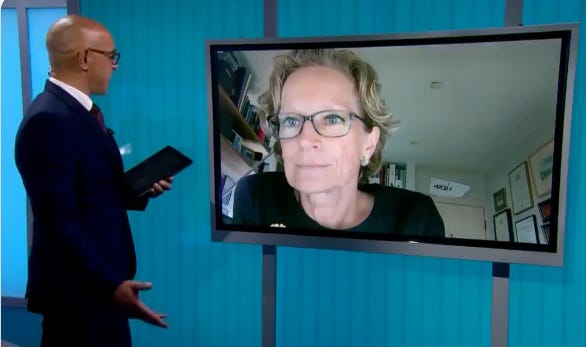
The interview is no longer available on the internet, but I recall that Annamarie Phelps started the interview smiling, seeking a friendly reception, whereas Mr Apiafi was belligerent from the outset; the smile slipped. Josh Apiafi demanded to know why the BHA had not done more to mark the death of George Floyd.
Annamarie Phelps replied:1
“Racing did discuss what we should do in the immediate awful moment a year ago, and it would have been really hypocritical of us I think - at that time - to have said anything enormously public and meaningful about standing alongside our black communities when actually we don't have very much ethnic diversity in the sport, and we had done probably at that time very little to try to be more inclusive. There's a whole raft of things, at all sorts of different levels, which are much more meaningful to those people, I hope, working in our industry than a grandiose statement which we had nothing behind at the time”.
This reply seems intended to outflank Josh Apiafi by being more Josh Apiafi than he was. What Annamarie Phelps should have said was: racecourses are not the place for Mr Apiafi’s BLM activism; no barrier exists to black people going racing; and if Josh Apiafi has evidence of racecourse staff being unwelcoming to black people, he should report it promptly. Had Annamarie Phelps kept to those positions, Mr Apiafi’s attacks would have been nullified.
Why did Annamarie Phelps, and by extension the BHA, end up in the position it did? By anticipating claims of ‘racism’ on account of horseracing’s ‘white’ demographics, they attempted to ward them off by making floating admissions. For example, on 14 June 2020, Annamarie Phelps said:
“In the light of the tragic killing of George Floyd and the discussions that have been ongoing about white privilege across our society, it is right that we acknowledge we haven’t prioritised tackling racism or diversity in racing as a sport, or at the BHA, as we should have”.
In so doing, the BHA created precisely the effect it was seeking to avert, because hostile activists were then free to refer to “problems” that were “admitted”. For example, Josh Apiafi said in a television interview on Sky Sports, 25 May 2022:2
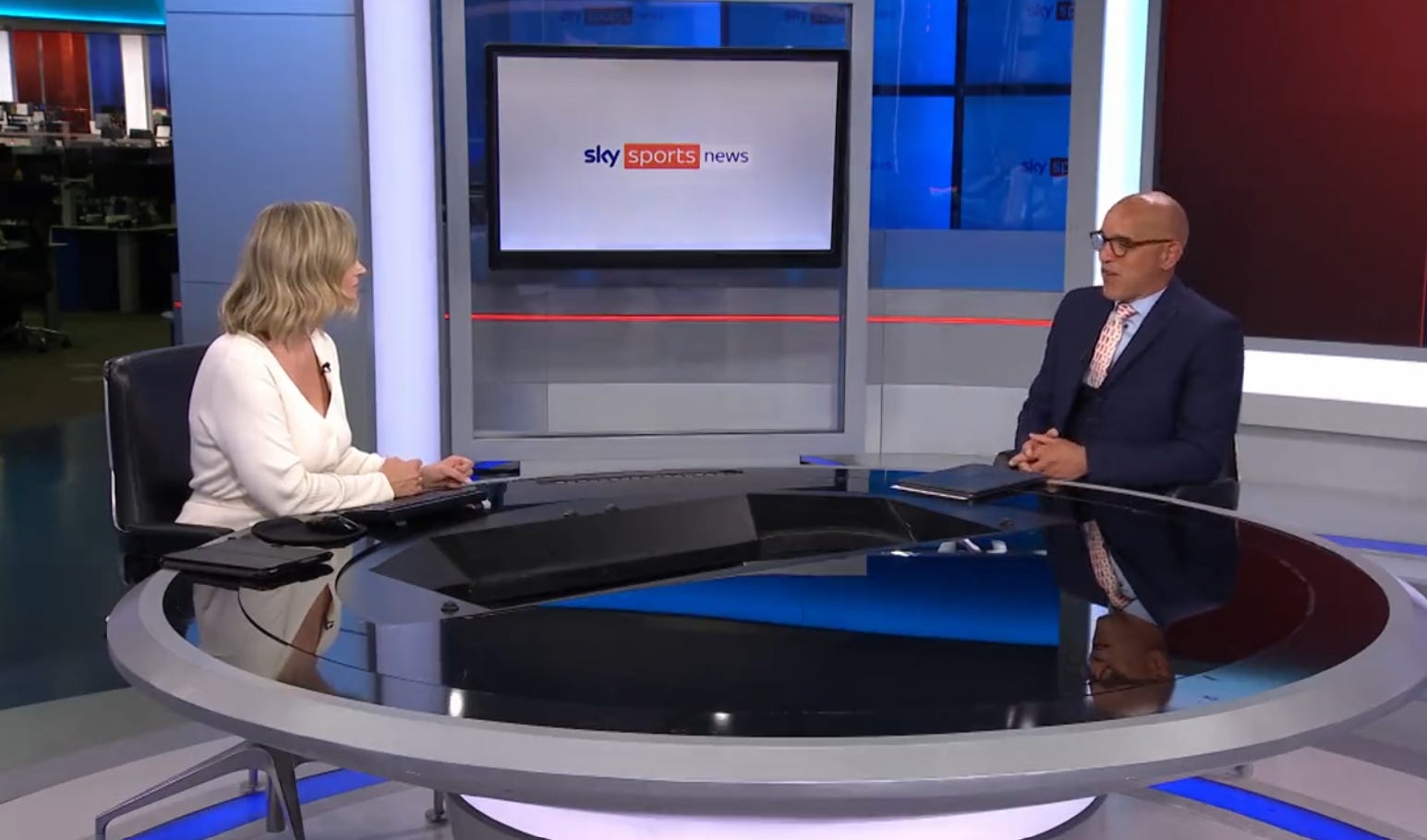
“It’s been slow Hayley, but I think you have to, first of all, realise there is a problem, and unfortunately racing was a little slow out of the blocks ... once they admitted there was a - there is a - a problem that needed addressing, they then put various different factors in place”.
What must viewers have thought - that black people had been denied entry to the racecourses, that they were expected to use segregated facilities? It didn’t occur to interviewer Hayley McQueen to ask! Only by working backwards can one discover that BHA admissions were floating admissions to floating accusations, and that the supposed “problem” didn’t exist.
The racing media’s lack of scrutiny
A recurring feature of racing television interviews was that presenters, there to talk about sport, had no skills with which to critically question diversity activists. But it was also the case that broadcasters such as Sky Sports Racing shared their opinions; for example, Hayley McQueen introduced the above interview by saying:
“It is two years on from the murder of George Floyd, an event that sparked the global conversation about diversity and led to most sporting organisations promising change. Today we’re looking at whether the promises are being kept. I’m joined on set by Josh Apiafi ...”
Sky Sports presented diversity as “global conversation” rather than, say, a cultural or ideological coup in white-western countries, with the rest of the globe looking on in incredulity.
Josh Apiafi later described Sky Sports as “huge backers” of diversity, giving him a “public voice to create change”.3 Sky Sports had its own diversity committee, of which Josh Apiafi was a member, and produced Mr Apiafi’s diversity TV programmes, such as The Uncomfortable Race. In common with the Racing Post (Chapter 8), Sky Sports had rendered itself incapable of objective or balanced reporting on diversity-related matters.
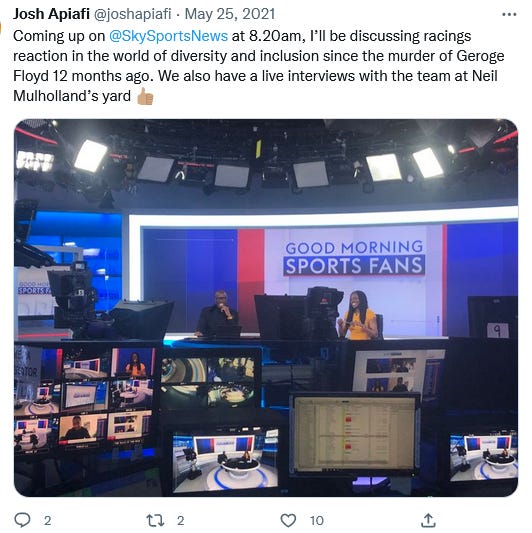
Josh Apiafi later explained his hostility to horseracing authorities in a podcast, November 2022:4
“There’s two ways of getting a horse to move forward, you either give it a kick or you give it a pat … I’ve done things where I’ve kicked the sport which was [when] we did a programme called The Uncomfortable Race where I personally sat down with three young black males … [racing] needed a kick … if you look at horseracing, it’s full of white privileged males, they might not think it, but their thinking is within, let’s say, 10% of each other”.
This is a strange thing to say; people in horseracing are employed on the basis of skills: equine roles, racecourse operations, stewards, hospitality, marketing, management, IT, administration, etc. The idea that people in the industry, white or not, have the same or similar thinking is not a serious proposition.
In another interview, Mr Apiafi said: “If you’re all the same white male people in a room, you’re all going to pretty much think the same”.5 In another: “our sport is still full of middle to old age white males … [if you go to Christmas bashes] it’s embarrassing when you look round the room”.6 Claiming to quote his father, Mr Apiafi likened Cheltenham crowds to a “Ku Klux Klan convention”.7
What offends Mr Apiafi - is it the thinking of “white male people”, or is it something else? All becomes clear when Mr Apiafi says:
“When you walk into a room, if no-one looks like you, you don’t feel comfortable and I’ve gradually become more and more uncomfortable in racing’s room”.8
This, then, appears to be Mr Apiafi’s motivation; he is “uncomfortable” around people of British ethnicity. He said during an interview on Sky Sports on 25 August 2019:9
“Rishi Persad and I have been trying to drive [ethnic diversity] for a long, long time, realising that we’re pretty much loners in the sport … it’s wrong when you look around and there’s no-one that sort of looks like you”.
I pass no judgment on Mr Apiafi feeling self-conscious among British or white people; this is not something he can control (I am sure many Britons would feel similar if they were the only white person at a football match in Africa). The question is why Mr Apiafi should translate his emotional reaction into an animus against white people, rationalised, at least in his own mind, by claims that they are “white privileged males” limited in their “thinking”.
Mr Apiafi had an active imagination in other respects; at Ascot Racecourse on 19 June 2021, he told Sky Sports presenter Gina Bryce,10
“Horseracing is run from 75 High Holborn within the M25, within the centre of London, one of the most diverse cities in the world, and it is a hundred percent white”.
During my time in the sport, the British Horseracing Authority and its predecessors have never been “100% white”, not in the Portman Square days (for me, 2002-2004), or at Shaftesbury Avenue (2004-2009), or when the BHA was based at 75 High Holborn (2009-2023). In early 2021, when the above interview was conducted, there were three black members of staff at 75 High Holborn. Either Josh Apiafi knew that 75 High Holborn employed black and ethnic minority staff and was lying, or he didn’t know the racial composition but purported to know it, in order to portray the BHA in what he thought was a bad light.
This was far from the only inaccuracy in Mr Apiafi’s public statements about diversity.
Writing for The Times of 5 August 2021, Mr Apiafi said in reference to George Floyd’s death, “every other leading sport voiced public support for the protests. But racing? It did nothing”. This claim is provably false; see Chapter 5.
Mr Apiafi made the same claim on The Paddock and The Pavilion podcast in May 2021, that horseracing’s leadership (which he dismissed as “a room of white people”) decided to “ignore what happened”.11 He repeated the false claim yet again in the Racing Post on 26 May 2021.
Speaking of the three young black men he interviewed in The Uncomfortable Race (Chapter 11), Mr Apiafi said: “these guys had reached out to me during the last year because they weren’t being heard, they were feeling hurt”.12 This is surprising, because Callum Helliwell, one of the three, said elsewhere that Mr Apiafi had contacted him and invited his participation in a “young guns” project that he, Mr Apiafi, was working on.
Mr Apiafi’s rhetoric peaked with demands for the “eradication of racism” from horseracing,13 implying black people were being subjected to widespread or systematic discrimination. Yet, this was never evidenced; in the above Gina Bryce interview at Ascot, Mr Apiafi said:14
“We’ve got a sport where the 600 most senior directors within the sport, there are two people that are from a minority and ethnic background, that’s fundamentally wrong. If you’re going to be reflective of society, there’s got to be problems, barriers or unconscious bias there that we need to overcome to make our sport far more reflective of society”.
Mr Apiafi did not identify the supposed “problems, barriers or unconscious biases”; he merely asserted “there’s got to be”. But Josh Apiafi had positioned himself as racing’s Mr Diversity; if anyone had an interest in identifying such causes, it was him. Yet, despite the “long, long time” he said he has spent on the matter, he could not offer a reason, other than the obvious explanation he avoided: the 600 directors are predominantly indigenous British because we are in Britain.
Despite all this hot air, or perhaps because of it, racing’s charitable arm, the Racing Foundation, saw fit to provide Mr Apiafi’s company Apiafi Associates with a £103,000 grant in October 202115 to launch the Racing Media Academy to “grow diversity within British Racing”.16 The following year, Apiafi Associates was awarded another £100,000,17 and a further £46,000 in 2023.18
Racing With Hannah, 9 November 2022 - 39m 15s
Racing With Hannah, 9 November 2022 - 29m, 31m 10s
Racing matters Podcast, 5 November 2020 - 20m 35s
Racing matters Podcast, 5 November 2020 - 23m 40s - Josh Apiafi’s usual account of this story is that his father said, “Not a lot of brothers here”. In this interview, the story is elaborated: “he basically said: have you brought me to a Ku Klux Klan convention”, followed by Josh Apiafi laughing. Regardless of who made the comparison, Mr Apiafi and his father walked among 75,000 white people in total safety.
Sky Sports Racing, 19 June 2021 - 5m 40s
These points should not be read as endorsement of the BHA’s engagement with BLM-related commentary or statements about George Floyd. A fatal incident in another country, unrelated to the sport and still under investigation at the time, fell entirely outside the scope and responsibility of the BHA’s chair and chief executive. The points in this essay relate solely to Mr Apiafi’s demonstrably false claims that the BHA “did nothing” and “ignored what happened”.
For example, during The Uncomfortable Race programme, and The Paddock and The Pavilion podcast.