
Chapter 17) Horseracing Conference, Windsor, September 2021
Diversity in conflict: Ethnicity Panels and Gender Research at the 2021 Windsor Conference

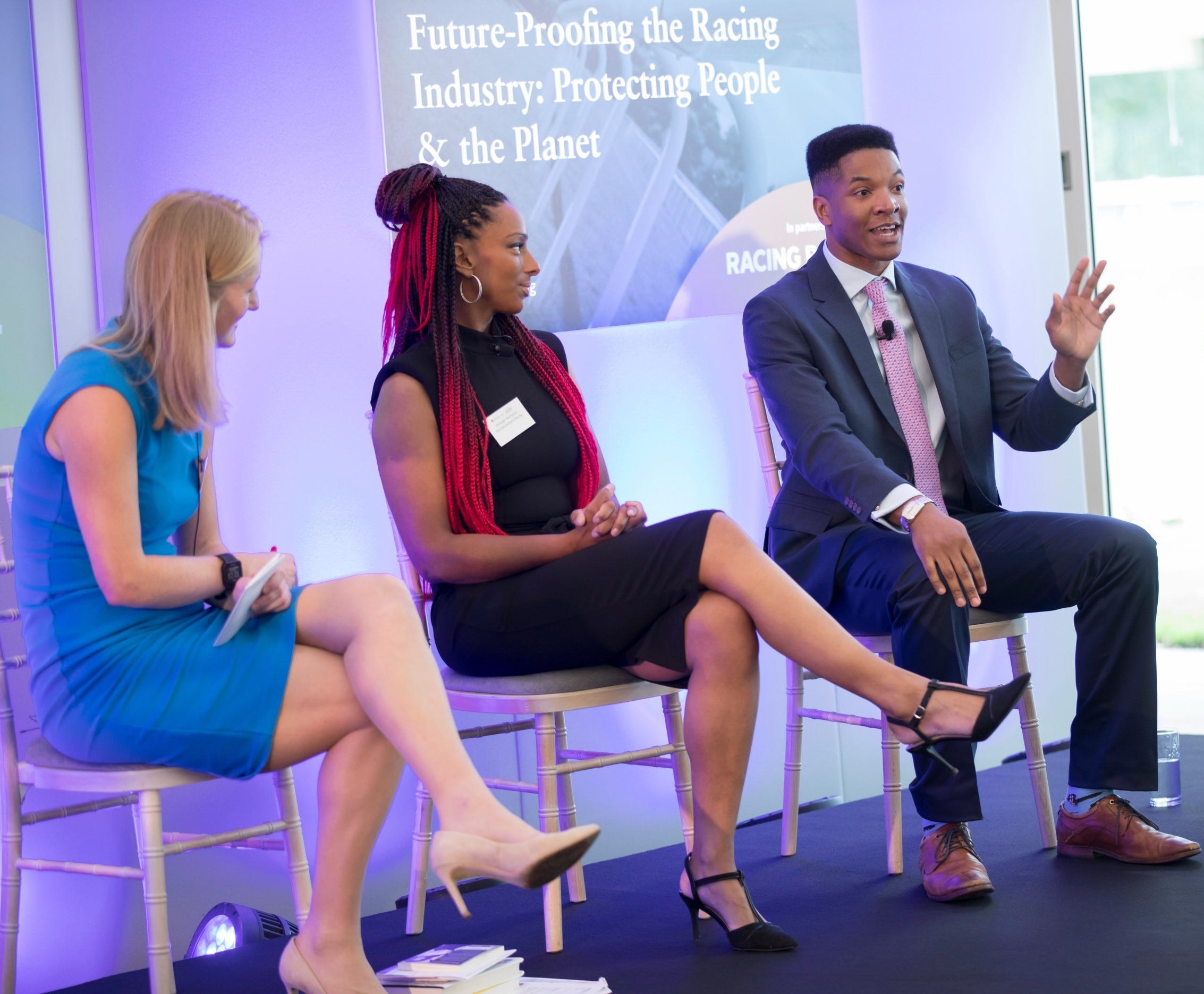
On 30 September 2021, the Racing Foundation, in conjunction with the University of Liverpool, held a one-day Horseracing Conference at Windsor Racecourse, entitled “Future-Proofing the Racing Industry: Protecting People and the Planet”.1 I was not present, but it was reported upon in Horse and Hound.2
The “Ethnicity in Racing” panel was in the morning, featuring Susannah Gill, chairwoman of the Diversity in Racing Steering Group since mid-2020; Callum Helliwell, who had appeared in the television programme The Uncomfortable Race (Chapter 11); and Ashleigh Wicheard, described in the programme as a travelling “head person”.
Susannah Gill was quoted as saying she was “sitting here pretty much as a posh white person”, and told a children’s story intended to exhort greater efforts towards diversity:
“There was once a mayor who wanted his town's fountain to run with milk on his birthday. Every resident was meant to empty in a jug of milk the night before, but on the day, the fountain ran with water. People thought that, if everyone else put their milk in, no one would notice, but everyone had thought that. And when it comes to ethnic diversity, I think that's what happens; everyone thinks someone else will confront it, but they're not. It's a conversation we should all have”.
Callum Helliwell said:
“Put yourself in someone else’s shoes and think about what it must be like from someone from a diverse background on a racecourse. At Cheltenham, you walk into a sea of tweed, with white people under it, and if you're not white and wearing tweed, you feel uncomfortable, as you feel you stick out. You find yourself wearing tweed and talking a different way, but the one thing I can't change is my skin colour. You have to feel you're accepted”.
Most people at racecourses do not, in fact, wear tweed - so what is Mr Helliwell talking about? He is referring to the effortless way English people fit English culture, and diverse people’s reaction to this. Mr Helliwell doubled down, saying people from diverse communities will not return to the races if they feel uncomfortable. Thus, English people are held responsible for diverse people’s reactions.
Mr Helliwell was also reported as suggesting the creation of alcohol-free and gambling-free “quiet zones” for Muslims. In a follow-up podcast a few weeks later, he said that such zones “would encourage people who come from communities where gambling and alcohol is forbidden to be able to feel safe enough to come racing”.3 This was at least the second time such areas had been mooted; BHA chief executive Nick Rust had alluded to them the previous year, suggesting that Leicester racecourse be reorganised so that Muslims were not, to use his word, “confronted” by the sight of betting and drinking.
The People Research Panel
The afternoon featured the People Research Panel, including Vanessa Cashmore and David Letts, who were conducting their ongoing PhD research into the performance of female jockeys, and LGBTQ awareness, respectively (Chapter 3).
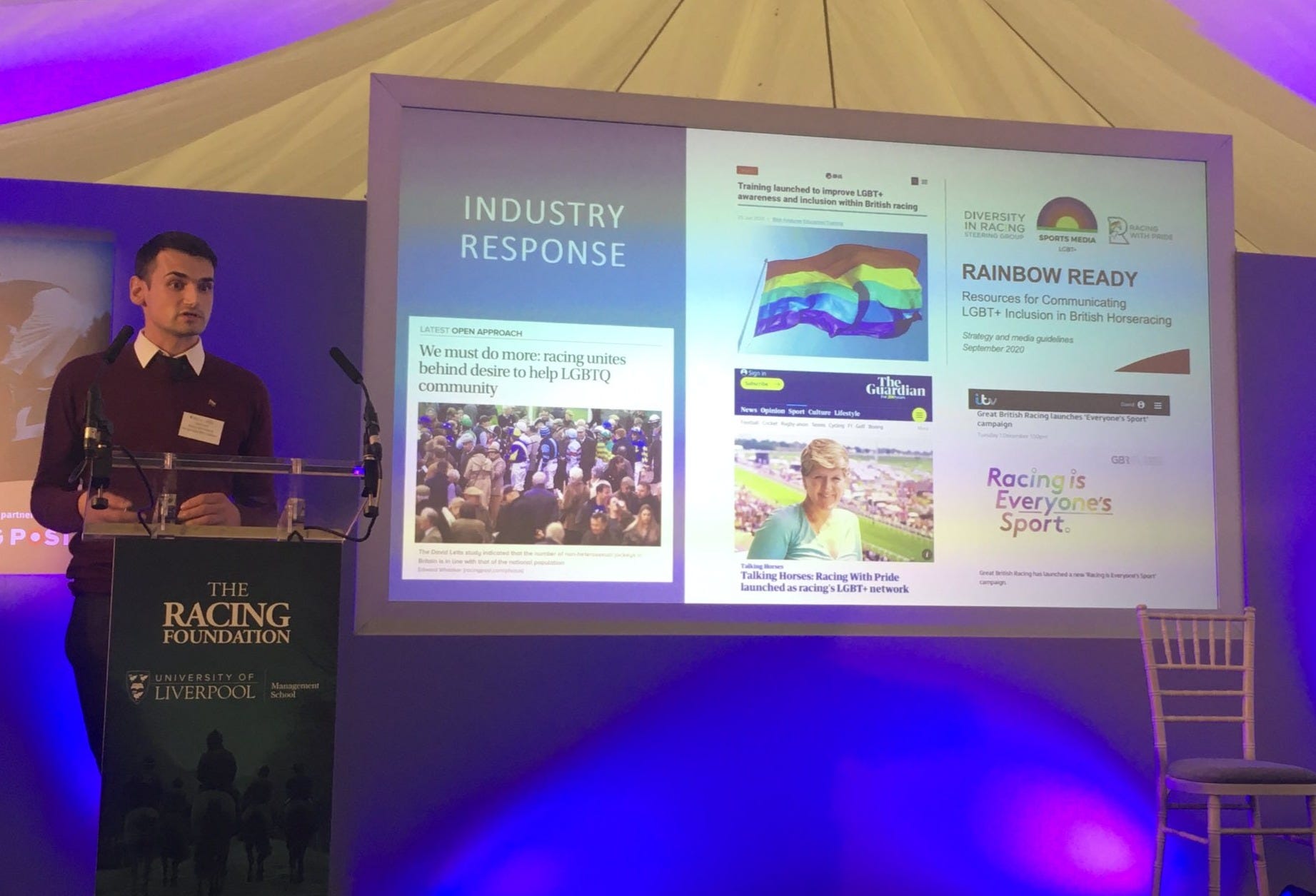
The panel also featured Dr Eleanor Boden who gave a talk titled, “Where did all the girls go?”, based on her PhD. She explained, “We wanted to know why young people, especially females, were coming into education and training but not continuing”. Dr Boden was quoted as saying sexual harassment was a major issue. She said that she found women were told their place was in the kitchen rather than on the yard, and offered rides in exchange for sexual favours:
“We're in a sexual harassment epidemic. It's a societal problem and racing can't be arrogant enough to think it's not happening in our spaces. Racing has a massive opportunity to get this right and lead ... Gender stereotypes are widely accepted and unchallenged, and those who succeed are ‘those who learn to play the game’, but women can never win. This is happening and it needs sorting. It's not going away, it's getting worse”.
I wanted to read Dr Boden’s PhD but the Durham University website said, “Author-imposed embargo until 19 October 2023” - a wait of two years!4
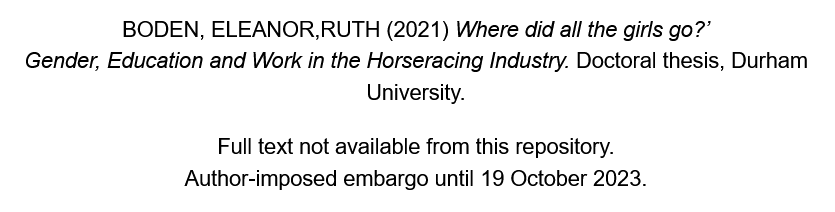
The research’s abstract, however, was available and indicated the research drew on intersectional feminist theory:

Sharia zones or LGBTQ & gender parity?
Didn’t the conference attendees think that there was an incongruity in promoting gender parity and LGBTQ in the afternoon, when Callum Helliwell had been advocating de facto Sharia zones, in the morning?
If racecourses were to implement Sharia areas that prohibit betting and alcohol, can Muslims also exclude women and gay people? Do diversity advocates prioritise Muslims over LGBTQ, or LGBTQ over Muslims?
There’s a more fundamental aspect to this. Consider two tribes: Tribe Diversity that promotes homosexuality, transgenderism, and gender parity, which reduce the propensity of a society to form families; and Tribe Traditional that promotes traditional male and female roles, and families. In a hundred years, which tribe is more likely to still be around? Not the first one.
Tribe Diversity will survive if protected by strong walls, moats, or mountain ranges, but Tribe Diversity also insists on racial diversity. Since European parents cannot produce non-European families, this means introducing non-Europeans (i.e. Tribe Traditional) into the territory of Tribe Diversity (white Western countries). The implication is that the birth rates of Tribe Traditional will outpace those of European societies that promote LGBTQ lifestyles.
Diversity’s Achilles’ heel
This is the Achilles’ heel of the whole diversity project. Although diversity is presented as a universal value, most accomplishments seen as progressive - racial equality, the emancipation of slaves, women’s lib, gay rights, and animal welfare - emerged at scale in white Western societies. This is due largely to white people’s idealism and individualism, stemming from a combination of the Enlightenment, Christian ethics, and post-War liberalism. Therefore, deprioritising Western families and eliminating ‘whiteness’ dismantles the demographic foundations of diversity advocates’ own worldview.
This tension applies not just to racing but the entire country. Should Britain, or large chunks of it, become like present-day Pakistan, Iran, or Uganda, due to the demographic changes that diversity activists want to see, what will happen to LGBTQ and women’s equality? Have horseracing’s diversity activists thought about that?
Here is Annamarie Phelps, BHA chairwoman from 2019 to 2022, promoting LGBTQ:5
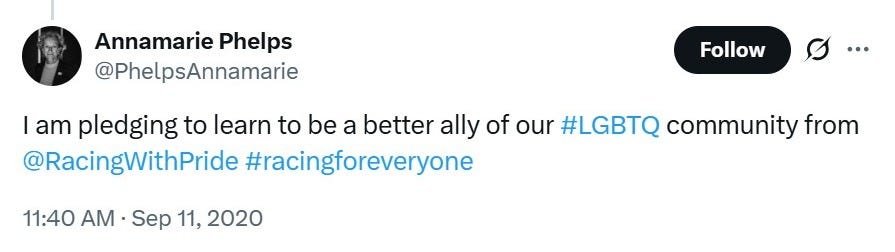
And here is Annamarie Phelps promoting Eid, the Islamic festival:6
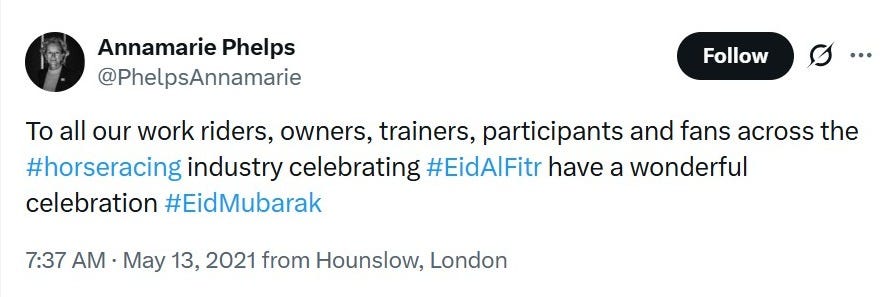
The contradiction in the two stances is obvious, so why is it ignored? At a technical level, diversity lumps together as “excluded” anyone who isn’t a “straight white male”, and so assumes commonality between groups that are definitionally in conflict: Muslims and gay people; gay people and transgendered people; transgendered women and biological women; women and devout male Muslims. More generally, Western people are comfortable; technology and debt have insulated Western society from the consequences of policies that are shifting the demographic tectonic plates. At least for the moment.
So, if diversity activists want to keep LGBTQ rights and women’s equality, they need to retain an ethnic British majority. If they want a multi-ethnic Britain, they must accept that the protection of women’s equality and homosexuality will very likely decline and may eventually disappear. One can have one, or the other, but not both.