
Chapter 14) From assimilation to alienation: staff Zoom call, June 2021
Marking the anniversary of George Floyd’s death, a Zoom call on race and ethnicity.

On 25 May 2021, the anniversary of George Floyd’s death, British Horseracing Authority (BHA) chief executive Julie Harrington invited BHA and Great British Racing (GBR) staff to a Zoom call on 8 June 2021. Four people participated: a female host, Julie Harrington herself, and two black guests, Paul Brewster and Callum Helliwell.
The previous day, Julie Harrington had said in her email to me (Chapter 13),
I hope the conversation today will allow us to hear some other views and discuss what role the NGB [national governing body] of a sport should/could be in these areas.
No such conversation transpired. I had expected a split screen with, say, nine or sixteen people, rotating between the hundred or so staff on the call, enabling people to participate in the conversation. Instead, viewers were restricted to sending comments electronically. Virtually the entire session was between the CEO and the two guests.
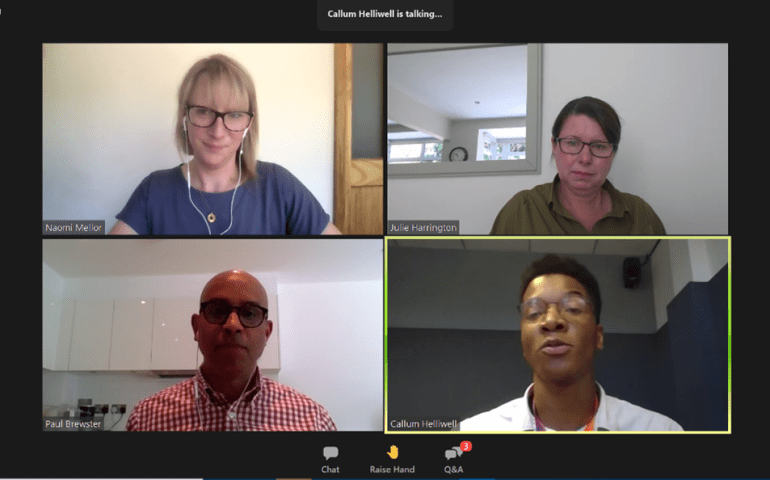
The host started by asking Julie Harrington,
“What do you say to people who have both on social media and more publicly said that this kind of conversation is not necessary, and that it is beyond the realm of the regulator to be involved in discussions about politics and race”.
The host didn’t say this objection had been raised by a member of staff, namely myself, in my email to Julie Harrington. By attributing my objections to people “on social media and more publicly”, staff were denied knowledge that objections had been raised internally.
The two guests introduced themselves:
Paul Brewster, a retired Barbadian jockey who moved to England in 2001, re-engaged with racing in 2011, and was appointed to Racing to School’s Board of Trustees in May 2019. He said: “I’d never thought that an opportunity would have been there for me to give back to the sport that gave me so much ... I have to thank the team at Racing to School [and] everyone at Careers in Racing who have made it possible for me to be able to give back to this sport and I will always be eternally grateful to them”.
Callum Helliwell joined the BHA graduate programme in 2018 and spent two weeks in Newmarket (“had the time of my life … got to be more involved in the industry than I could ever have dreamed” and “changed my life really and gave me a target”) and three months at Great British Racing (“another great experience”) followed by working at the National Stud for six months. He moved to work in television at Sky Sports Racing. “I’m living the dream and I’m very, very lucky to be doing that”.
Neither of these testimonies are of people who had been racially mistreated. Yet by the end of the Zoom call, Callum Helliwell was saying:
“I suddenly had this horrible feeling in my gut that people didn’t want me and people didn’t feel comfortable with me being there and my very presence made them feel in a negative way … I was angry … [white people think] everything is okay because they’re not burning a cross and have a white hood over their head”.
Paul Brewster added:
“Listening to Callum, I mean, it is so sad you come into a sport and you’re trying your best and people are judging you based primarily on the colour of your skin. That is so ludicrous but it happens and I think a lot of it needs to be addressed through education … You look at things like the apartheid era, you look at the civil rights movement in America”.
Crikey - white hoods, apartheid, burning crosses; what happened? Two things. Mr Helliwell explained:
“I didn’t consider myself black until I went to university ... there was the Afro-Caribbean society [which] I didn’t want to join … because I believed that was a negative thing [but] I remember Philando Castile, and many other deaths at the hands of [American] police officers. I [was] up in arms about that, and being told [by friends] ‘Oh Callum, that’s an American thing’, and ‘if he didn’t run that wouldn’t happen’. Eventually, I started to believe this [and then] George Floyd happened, and then suddenly you realise … I’m just being told not to say anything”.
Helliwell was agitated by what he believed was happening in the United States. For him, this was introduced into horseracing when he was asked by Josh Apiafi to take part in Mr Apiafi’s television feature, “The Uncomfortable Race” (Chapter 11):
“I got a phone call from Josh … I had never spoken with him … he contacted me and said, would you like to be part of this young guns project that I’m doing ... we did the documentary … basically the three of us [and Josh Apiafi] discussing .. racing’s lack of action post-George Floyd in comparison to other sports, how it affected us, and … how to get more people from ethnically diverse backgrounds and other diverse backgrounds into the sport, and what racing can do”.
Note the reference to a “young guns project”. The context here, of course, is young black people competing with older white people. I had never heard people talk of “young guns” in horseracing before; young jockeys or trainers were assumed to be joining and continuing the racing tradition, not challenging or competing en bloc with older people.
Helliwell said that after the TV programme was broadcast, he received the following backlash:
“… there was a very negative reaction on social media ... I was trying to do my job and I was in the job of my dreams and I was really, really happy … and then I went on social media and I saw this storm of comments … it hit me like a ton of bricks ... the responses were so raw and so visceral … And it was from people’s public accounts ... I’ve seen these people on racecourses, I knew lots of these people from when I was working at sales”.
Mr Helliwell’s “trying to do my job” misses the point; he had been accepted in racing, then criticised the sport on television for failing to support Black Lives Matter, describing racing as “left behind”. That’s what led to the reaction. It is similarly incorrect for Paul Brewster to claim that Helliwell was being judged on the colour of his skin.
Mr Brewster’s comparisons to apartheid are mystifying. Apartheid was a policy of racial separation in South Africa; for example, black people could not live in white-designated regions. British horseracing does not operate such a policy; there are no ‘white’ racecourses in Britain. Racecourses are ‘white’ only in the sense Britain is a part of the world where white people live; if one goes to India or Hong Kong, one will see racecourses with non-white people.
The host asked Mr Brewster the following question: “Paul, you are one of the few black board members within British Racing, if not potentially the only one. Is that something you have been conscious of during your career?” Paul Brewster replied, “Well to be honest with you I did not even realise that I was one of the very, very few. That was shocking to me. Obviously, it demonstrates that the industry has got some work to do in that area”.
What exactly was Mr Brewster expecting when he moved to Britain - a demographic mirroring that of his home country? But there’s another point to be made; if Mr Brewster is dissatisfied at the lack of black directors, had it occurred to him that it is black people who have work to do, rather than the industry?
If there was any message to come from this Zoom call, it was that Mr Brewster and Mr Helliwell had assimilated successfully, and in a natural way, but that acceptance had been hijacked by diversity activism. Josh Apiafi had sought out Callum Helliwell because he was young and invited him to make televised criticisms without applying control for accuracy or nuance. This led to the backlash from those criticised, leaving Helliwell distressed.
Josh Apiafi couldn’t have been unaware that using Helliwell in this way might cause such a reaction, because he had done the same thing with Rishi Persad (Chapter 8). But whereas Mr Persad was 47, Callum was only 24. He had been turned from a happy and assimilated member of the horseracing community into someone disaffected and alienated.
The timing of this Zoom call should also not be overlooked. Invitations were sent on the anniversary of George Floyd’s death, portraying his death as a ‘wake-up call’ for staff in horseracing’s governing and marketing bodies. The call was designed to illustrate the new perspective and parameters staff were expected to accept and work within, as the BHA moved to change the sport’s racial composition.