
Chapter 16) From gender parity to gender diversity

In most sports, men and women compete separately due to the average male advantage in strength and athletic capacity. Yet the report used to launch the BHA’s diversity policy in May 2017 appeared to resist such differences. The Oxford Brookes University’s report into women’s representation in racing included the following passage:1
A central argument raised for the differential in success is a perception held by some that women are biologically inferior, and that it follows that trainers/owners will choose men over women because they perceive that men are stronger. (p36)
“Inferior” is a loaded term - likely the authors’ own projection - and trainers and owners do not “perceive” men are stronger. Men, on average, have a stronger grip, more muscle mass, and greater upper-body strength. In strength-dominant sports, these differences justify separate male and female categories.
Horseracing, however, is regarded as a test of skill in which the horse supplies the power, allowing men and women to compete on equal terms. This fitted the progressive outlook of the BHA’s new diversity policy: from 2017, it declared “pride” in the equality aspect and, in 2020, Great British Racing (GBR) launched a “Just Jockeys” campaign, promoting,
“… the need for us to drop the term ‘female jockeys’ and celebrate the sport as one … Racing has no gender, it’s your skill and talent that counts”.2
Despite the contradiction, GBR launched this campaign in conjunction with International Women’s Day:

One can see in the slogan “racing has no gender” the roots of “gender diversity”: if one accepts the principle that distinguishing between male and female is unnecessary and outdated, why should being male or female even matter? This way of thinking is consistent with Gender Theory, whereby male and female are redefined as one category, “cisgender”, while other gender identities include “trans”, “non-binary”, and “gender fluid”.
Gender Theory goes against physical reality; women give birth, not men. Yet, a BHA staff survey in 2019 used the terms “pregnant person” and “breastfeeding person”, and Racing2Learn’s LGBTQ module (Chapter 6) taught that people are “assigned” their sex on birth, rather than it being observed and recorded. In March 2022, BHA staff were asked to consider adding their pronouns to email footers, and racecourses sought to introduce “gender diversity” via drag queens and Pride events as part of racing’s new calendar (Chapter 15).
Drag queens
In March 2022, Hereford racecourse hosted drag queen Boo La Croux for Ladies Day:3
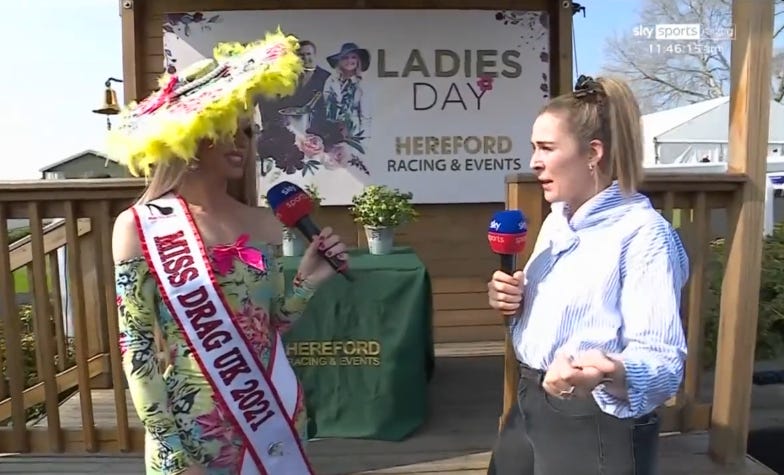
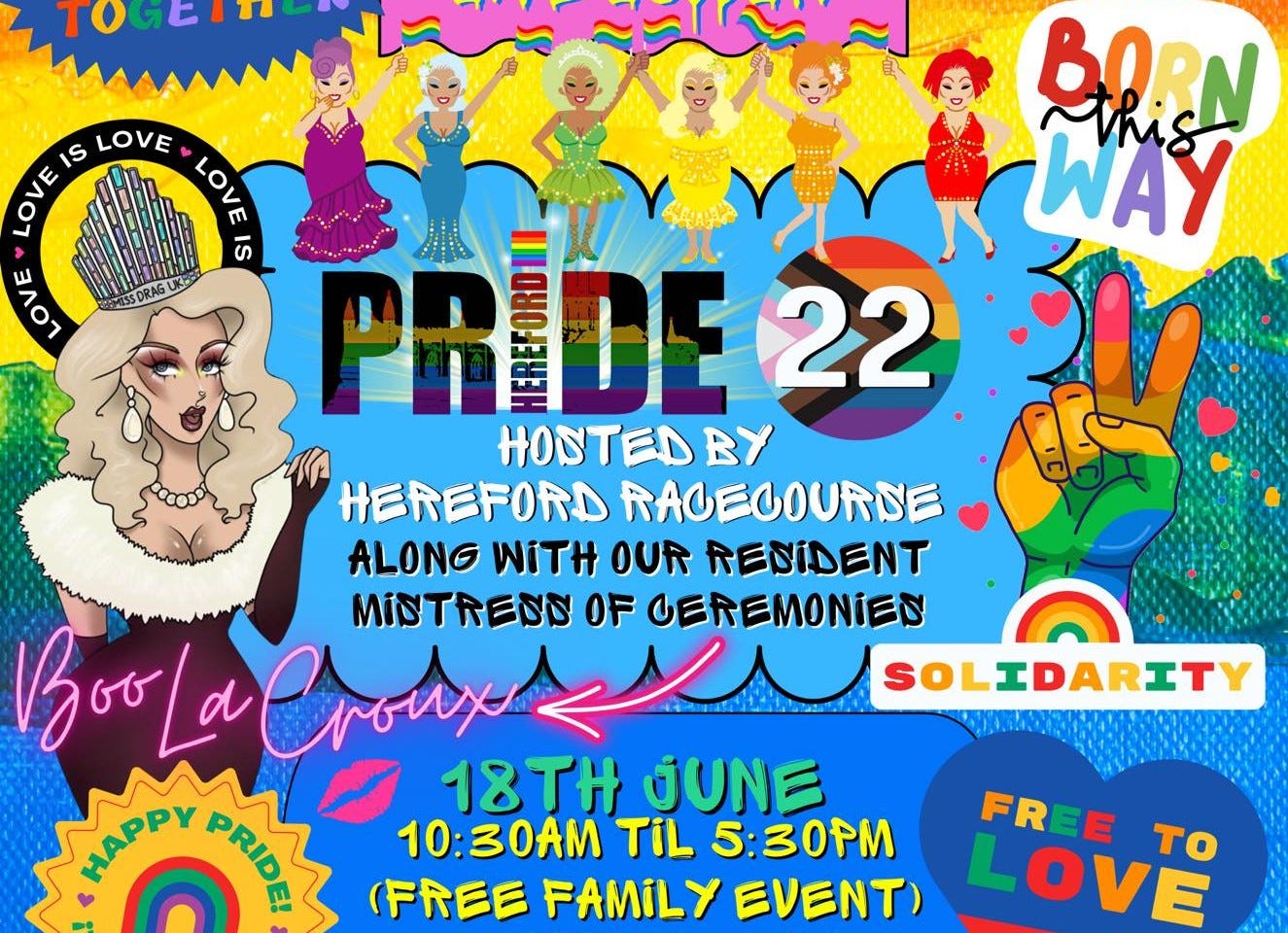
Having men dressed as women for Ladies Day might be considered a wheeze, but this is not comparable to, say, a guest appearance by Hinge and Bracket, who acted in character. Boo La Croux’s appearance was a precursor to Hereford racecourse hosting “Pride 22” in June.
The same month, the Jockey Club invited the late George Ward, in drag as Cherry Valentine, to Ladies Day at Epsom Downs, where he joined a panel to judge the fashions. George Ward identified as “genderfluid”, and used they/them pronouns. The Jockey Club said in its press release:4
The most inclusive Style Awards yet, guests of all identities are encouraged to enter and showcase their Ladies Day attire … As part of its journey to grow and evolve, The Jockey Club has implemented several initiatives focusing on gender, race and supporting LGBTQ+ communities.
Pride Events
Since 2022, other racecourses have hosted Pride events. It’s normal for racecourses to be hired out for private events, such as conferences and weddings. If a Pride group wishes to hire a racecourse for an event, the racecourse can accommodate them in the same way. If parents choose to bring their children, that is a matter for parents, not the racecourse.
But that’s not the situation; racecourses have explicitly tied themselves to Pride and LGBTQ by flying Pride flags and messaging, all endorsed by the Racecourse Association:5
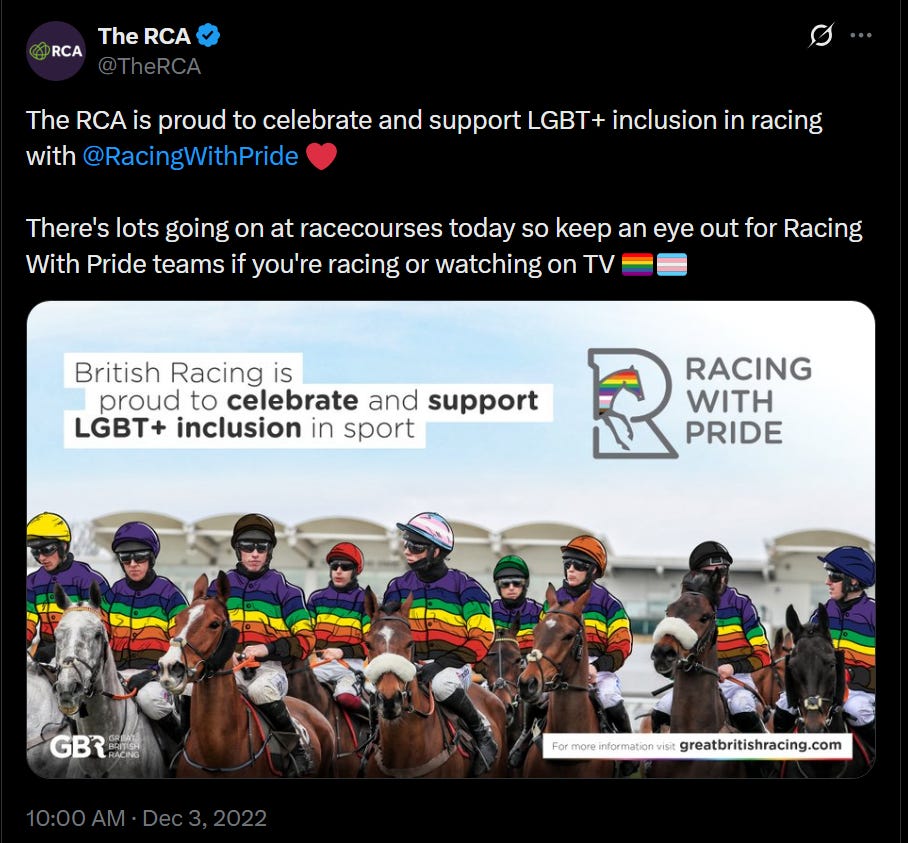
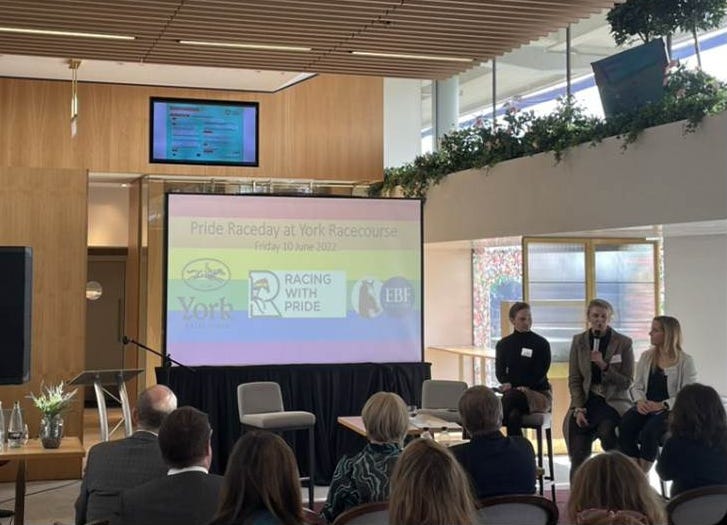
The Racecourse Association supports Racing With Pride, the LGBTQ group set up with the blessing of the BHA. The below photo shows Racing With Pride at York Racecourse:6
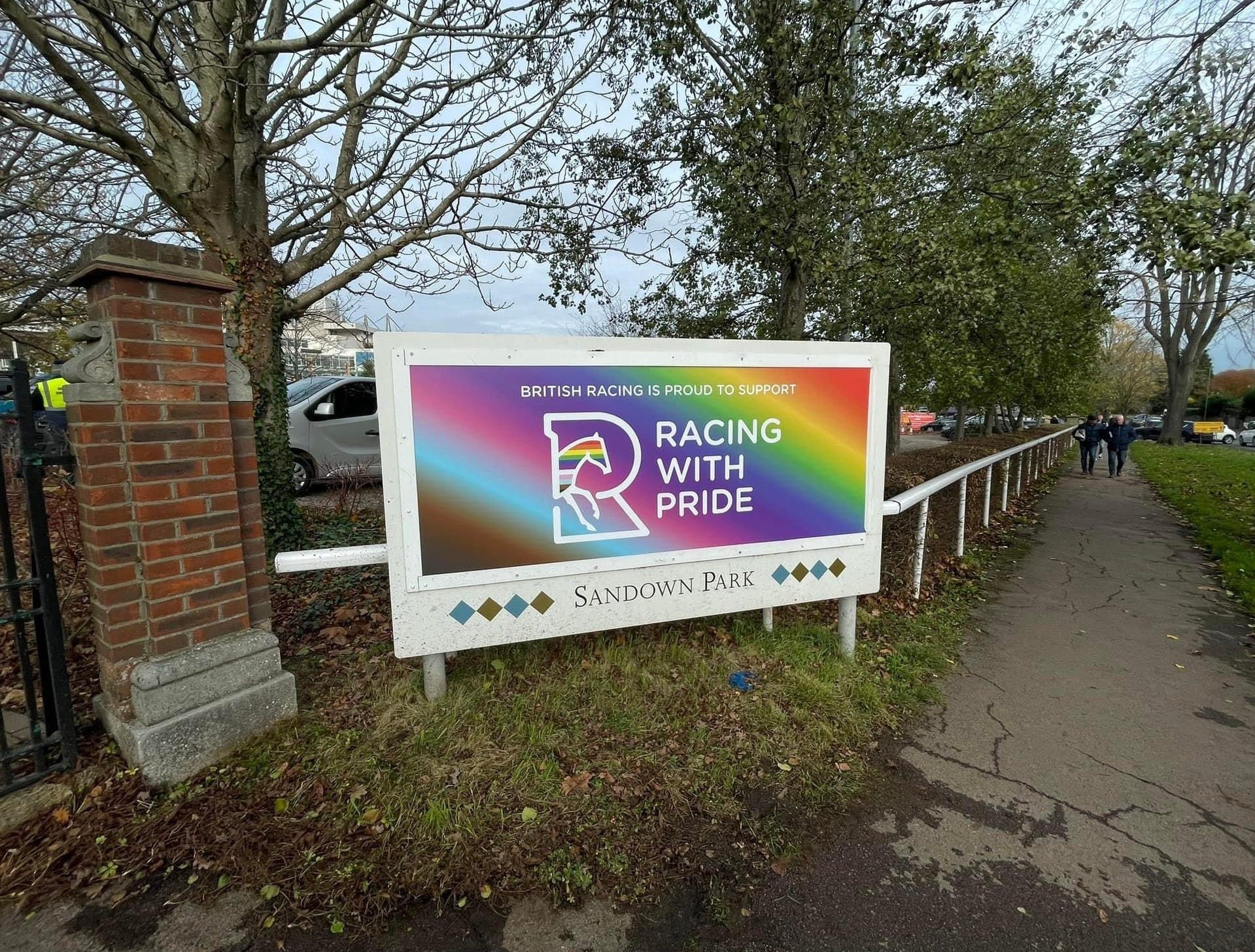
This sign at Sandown, owned by the Jockey Club, states “proud to support Racing With Pride”:7
Racing With Pride is not just a social or support group; it engages in activism. According to its own description, it seeks to “influence social change and promote a diverse and inclusive industry”.8
In June 2023, Epsom racecourse held a “LGBTQIA+ celebratory area” (i.e. lesbian, gay, bisexual, transgender, queer, intersex, and asexual). It was hosted by drag queens and included a free library of LGBTQIA+ literature and a music stage on which children danced. Drag queen Le Fil said,9
“We’ve just been welcoming everyone to the stage, having a dance, having a boogie, it’s been a lot of fun. We’ve had so many lovely little kids coming up to perform. Like we’ve been going, ‘do you want a lip sync’ and they’re like ‘YES’ so we’re like ‘come on and show us what you’ve got’”.
In explaining the event, the Jockey Club said:10
“The Jockey Club is passionate about making horse racing an open and welcoming sport for all. The research that has been undertaken highlights there are not enough spaces created with the LGBTQIA+ community in mind at major sporting events and this initiative is only the first step in exploring what part The Jockey Club can play in helping to address that”.
However, another of the drag queens at Epsom, Cara Melle, said to Pink News:11
“It’s really important that we are there because it’s about normalising the culture and normalising what we do, and letting people of all ages take in this confidence that we always exude when we go on stage and we’re performing or having a good time”.
Note the clear divergence in explanations. The Jockey Club presents this as a “welcoming sport for all”, but Cara Melle says the objective is normalising LGBTQ for “all ages”.
Homosexuality was legalised in 1967, and age of consent was equalised in 2001. The purpose of modern Pride is therefore not legal equality or protection from discrimination, but achieving social equality between LGBTQ lifestyles and traditional family norms. If one believes in this goal, introducing it to children is not radical, but merely a logical extension. Children do not understand LGBTQ, but they do respond to colour, music, and dancing. Associating LGBTQ with fun in the minds of children helps normalise it. When combined with similar messaging in schools and media, this can influence teenagers toward life-changing choices before they are mature.
Safeguarding vs Activism
The National Horseracing College EDI Policy excerpt below lists “protected characteristics” under the Equality Act 2010:12

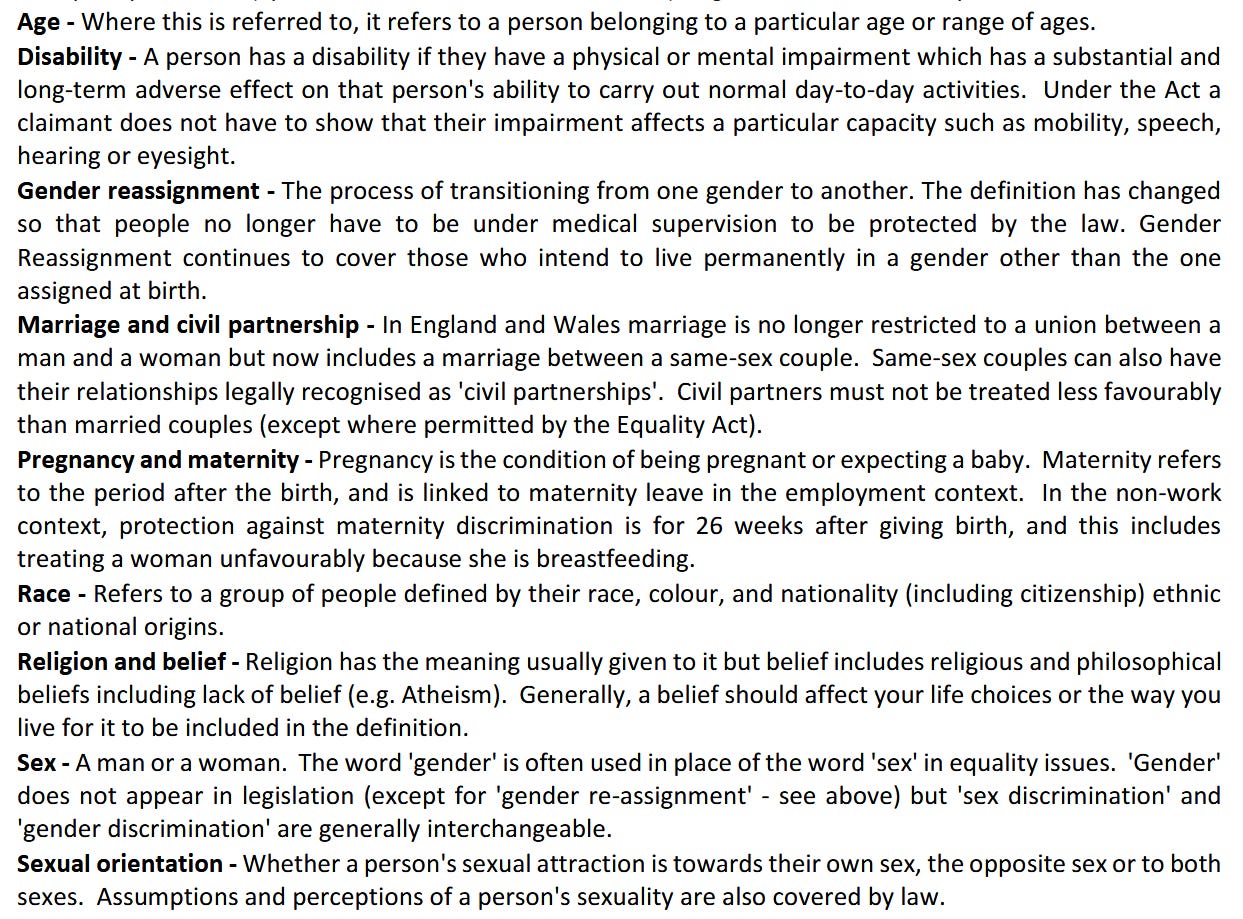
Children are not specifically identified, which is something of an oversight, but they fall under “Age”. Gender reassignment and sexual orientation are also covered.
When racing authorities promote Pride events and allow LGBTQ activists to shape public discourse, particularly by presenting LGBTQ people as victims, any conflict between promotion of LGBTQ causes and protection of children can be resolved in favour of the former.
Children need adults to speak for them, but horseracing’s position is that people must be “allies” to LGBTQ, with opposition to LGBTQ being proscribed as “homophobia” and “transphobia” (Chapter 4), words that are ill-defined and stretchable. This creates pressure to suppress protective instincts toward children, while LGBTQ activists become the group to be protected.
Previously, these issues were worked out in the public square, but racecourses were for horseracing. The British Horseracing Authority and other bodies have waded into matters far outside their remit - fraught with moral hazard - while relying on diversity advocates for direction and validation.